Cover and Title Page
IE 101
Innovation and Entrepreneurship 101
A Textbook for Project-Based Learning Courses
- Behaviors from the Berkeley Method of Entrepreneurship
- Execution methods from Innovation Engineering
Ikhlaq Sidhu
IE Silicon Valley Hub | CITRIS | UC Berkeley
IE 101
Innovation and Entrepreneurship 101
Mindset from the Berkeley Method, paired with the execution process from Innovation Engineering.
A textbook to scaffold project-based learning courses from tech entrepreneurship to challenge-based labs to corporate innovation capstones.
Ikhlaq Sidhu
Dean & Professor, IE School of Science & Technology
Senior Fellow, UC Berkeley at CITRIS
Founding Director/Chief Scientist, Berkeley Sutardja Center, Fung Institute, ELPP, and Data-X programs (2005-2022)
Front Matter
Copyright and Use
Prototype edition v3.1. This working manuscript is intended for instructors, students, and teams using IE 101 as a practical project guide.
The book is designed to be free to use in courses and downloadable by chapter as the material continues to be refined.
Source Lineage
IE 101 brings together behaviors from the Berkeley Method of Entrepreneurship with execution methods from Innovation Engineering, adapted for current project-based learning courses.
Acknowledgments
Before we go any further, this book would simply not have been possible without the contributions of so many executives, technical leaders, entrepreneurs, colleagues, and friends.
This book builds on years of teaching, experimentation, and collaboration across UC Berkeley, the Sutardja Center for Entrepreneurship & Technology, Innovation Engineering, Data-X, IE University, and many project-based courses and programs.
The material reflects the work of students, teaching teams, industry partners, entrepreneurs, researchers, and colleagues who tested these methods in real projects and helped make the framework more practical.
Special thanks are due to the communities that shaped the Berkeley Method of Entrepreneurship and to the Innovation Engineering work that provided the original execution framework for this version. This includes the innovators in the cases studies Richard Din co-founder of Caviar, Imprint Energy Co-Founder Christine Ho, Nir Merry from Applied Materials, Andrew Laffoon co-founder of Mixbook, Jayanta Dey at VMWare, Michael Shebanow IEEE Fellow and engineering leader, and Luke Kowalski Oracle executive and Berkeley instructor. I would also like to add thanks to executives who have taught within my programs including Charlie Giancarlo former chief product officer at Cisco, Mike Olson co-founder of Cloudera, author & entrepreneur Steve Blank for his many supportive conversations, Rich Redelfs formerly Foundation Capital, 3Com, and Qualcomm, Jerry Fiddler founder of WindRiver, Michael Marks former Flextronics CEO, Jim Davidson co-founder Silver Lake, Charles Fan former VMware executive and entrepreneur, Tesla co-founder Marc Tarpenning, venture capitalist Shomit Ghose, Mai Le from Uber and Yahoo, and many more. I can recall at least one important concept from each of them that has been synthesized into this book.
Further, adding to this list, are our major benefactors of the Sutardja Center at Berkeley, In Sik and Isabelle Rhee and Pantas Sutardja and Ting Chuk. And thanks to my colleagues including Phil Kaminsky former department chair and associate dean, who actually advised me to write this book, Ken Singer with whom I developed the Berkeley Method of Entrepreneurship pedagogy, our former deans during the development of the Center, Shankar Sastry and Richard Newton, our current Dean Tsu-Jae King Liu for her support during its current growth, IEOR department heads in this period Lee Schruben, Rhonda Righter, Ken Goldberg and Max Shen, co-founders of the Center Jon Busrgstone & Stacey Lawson, Tom Byers at Stanford for a long term support and collaboration, Paris de L’Etraz at the IE Business School whose expertise includes mindset & comfort zone and with whom I’ve collaborated on many real life technology business projects, Alfred Tan at HKBU who inspired a global educational application for this text, Bjorn Hartmann as a collaborator and head at Berkeley’s Jacobs Institute of Design Innovation, and the team within the Sutardja Center including Jocelyn Weber who worked with me to develop our executive leadership programs, Alex Fred Ojala who co-developed Data-X, Keith McAleer our communications expert, Victoria Howell who continually provides great feedback, and Kyle Giffin who led the editing process.
Foreword by Tom Byers, Stanford University
Adapted from original Innovation Engineering book, 2019
Over the past several decades, we have revolutionized our understanding of entrepreneurship and technological innovation. Widespread technological progress has allowed innovation to expand beyond the start-up world and into a wider sphere of society. These developments continue to change lives for the better.
Thus, we are brought to the purpose of this book. IE 101 will help students and teams create and innovate, building upon lessons developed in Silicon Valley, at the University of California, Berkeley, and now in an expanded context at IE University. Whether the creation is a new company, a start-up within a larger firm, a government project, a company capstone, or a new technology, the principles here provide a practical framework for innovation and execution.
Most innovative projects still fail to accomplish their goals. Many fail to launch even when the teams are intelligent and highly skilled. What missing piece could give these teams the edge to succeed? The answer is a practical framework for ideation and execution. This book lays out common roadblocks and provides solutions in a manner that is direct and simple to use.
Ikhlaq Sidhu has been a colleague and partner of mine for many years, working extensively with collaborators to develop innovation programs at UC Berkeley and beyond. I feel fortunate to have collaborated in support of this work since the early days of the Sutardja Center for Entrepreneurship & Technology.
The concepts in this book have been iterated, tested, and improved through a large journey that includes technical innovations, new venture creations, corporate research projects, and project-based learning. IE 101 should be understood as Innovation Engineering revised and expanded: it preserves the Berkeley lessons while extending the viewpoint for current innovation and entrepreneurship courses.
Tom Byers
Founding Faculty Director, Stanford Technology Ventures Program (STVP)
Bass University Fellow in Undergraduate Education
Stanford University
Table of Contents
Prototype edition. Final page references will be generated after copyediting and final pagination.
FRONT MATTER Cover | Title Page | Copyright and Use | Acknowledgments | Foreword | How to Use This Book | The Project Method
CHAPTER 0 Introduction: IE 101 and the Project Journey
Practice Exercises and Questions | Project Guide | Game-based Exercises for Behavior and Mindset
CHAPTER 1 Starting with Opportunity, Challenge, Change, and Team
CASE STUDY Richard Din and Caviar, with case questions
CHAPTER 2 Developing a Better Story
CASE STUDY Airbnb Pitch Deck as Entrepreneurial Narrative, with case questions
CASE STUDY Oracle Changes Enterprise Procurement, with case questions
CHAPTER 3 Common Strategic Errors and Story Narrative Mistakes
CASE STUDY VMware Scaling Innovation in Mobile, with case questions
CHAPTER 4 Execution While Learning: Building, Testing, and Getting Traction
CHAPTER 5 Common Mistakes: Strategy, Story, Evidence, and Execution
CHAPTER 6 Innovation Leadership
CASE STUDY Mixbook Navigating Innovation, with case questions
CHAPTER 7 Culture, Mindset, and Behavior
CASE STUDY NVIDIA 2005-2010, with case questions
CHAPTER 8 Technical Behaviors for Innovation
CASE STUDY Imprint Energy and Christine Ho, with case questions
CHAPTER 9 The Solution Explained in 12 Principles
APPENDIX Sutardja Center Back Story | Data-X Case | Index of Terms
How to Use This Book
Use this book as a substrate for a project-based learning course. The focus is not only entrepreneurship discussion, but a practical project journey from entrepreneurship to innovation. The course may be formatted as a challenge course, a technical venture course, a company capstone, a research translation course, or another practical project or design-oriented course.
| Example: In a company capstone, the customer may be an internal business unit. In a research translation course, the customer may be a lab, partner, patient group, or future adopter. |
The order matters. Students first choose or interpret a project. Then they form teams, create a story, develop NABC, validate customers, design the product, build demos and MVPs, seek traction, iterate, and present a final demo and reflection.
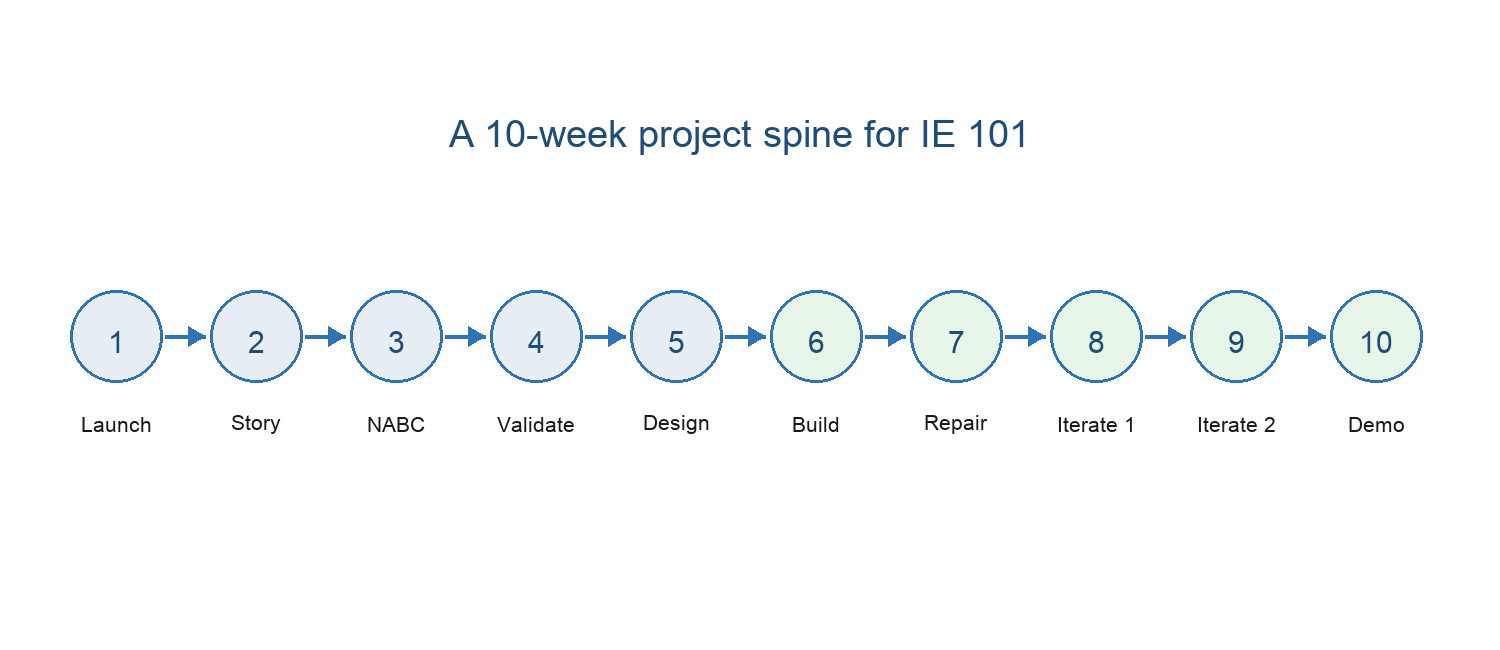
Figure 1. A 10-week project spine for IE 101.
| INSTRUCTOR NOTE: The most important design choice is to require evidence of execution every week. A better story matters, but it should be connected to what students learn from customers, prototypes, demos, stakeholders, and technical tests. |
Example Course Structure
Innovation project courses pair two streams: an entrepreneurship spine and instructor-defined subject matter. This 10-week structure shows how IE 101 concepts align with agile project execution.
| 1. Launch |
Course frame; opportunity; innovation mindset; team norms; initial assumptions. |
Form team. Select challenge. Draft project intent. Start evidence log. |
X |
| 2. Story |
Problem story; user need; customer/beneficiary; why now; discovery plan. |
Write user/problem story. Identify stakeholders. Schedule 5-8 interviews. |
X |
| 3. NABC |
Need, Approach, Benefits, Competition; value proposition; riskiest assumption. |
Draft NABC v1. Choose the assumption to test first. Define evidence needed. |
X |
| 4. Validate |
Validation; interviews; experiments; falsifiable claims; evidence quality. |
Run first test cycle. Interview/test 3+ people. Revise NABC. |
X |
| 5. Design |
Low-tech demo; prototype fidelity; user journey; tradeoffs; feasibility path. |
Build storyboard/mockup/demo. Show users. Define technical proof path. |
X |
| 6. Build |
Agile sprint; MVP; proof-of-concept; technical risk; build-test-learn. |
Run build sprint. Produce artifact/proof. Track decisions, risks, blockers. |
X |
| 7. Repair |
Failure modes; objections; missing evidence; repair strategy; team coordination. |
Fix weakest part. Re-test. Update story, prototype, and sprint plan. |
X |
| 8. Iterate 1 |
Traction; adoption; benefit proof; stakeholder pull; comparison. |
Run second iteration. Collect data, feedback, usage, or commitment. |
X |
| 9. Iterate 2 |
Integrated story; evidence gap; demo logic; implementation path. |
Close final evidence gap. Draft deck, demo script, and recommendation. |
X |
| 10. Demo |
Evidence-backed story; what is proven; reflection; next action. |
Present demo. Submit artifact, evidence summary, and team reflection. |
X |
Grey column note: X = a placeholder is where the instructor adds the natural subject matter, technical concepts, tools, data, design constraints, or domain-specific ideas that match the scope of the course project.
The Project Method
IE 101 has two forms of progress: story development and execution. Story gives language, purpose, and strategy. Execution gives evidence. Neither is sufficient by itself.
In a real project, technology, entrepreneurship, and design do not happen in separate phases. A typical 10- to 12-week course starts by finding an insightful story, moves through low-tech demonstration and technology strategy, then uses repeated iteration to arrive at a credible solution demo. Theory, tools, code, and behavior practice run underneath the whole project.
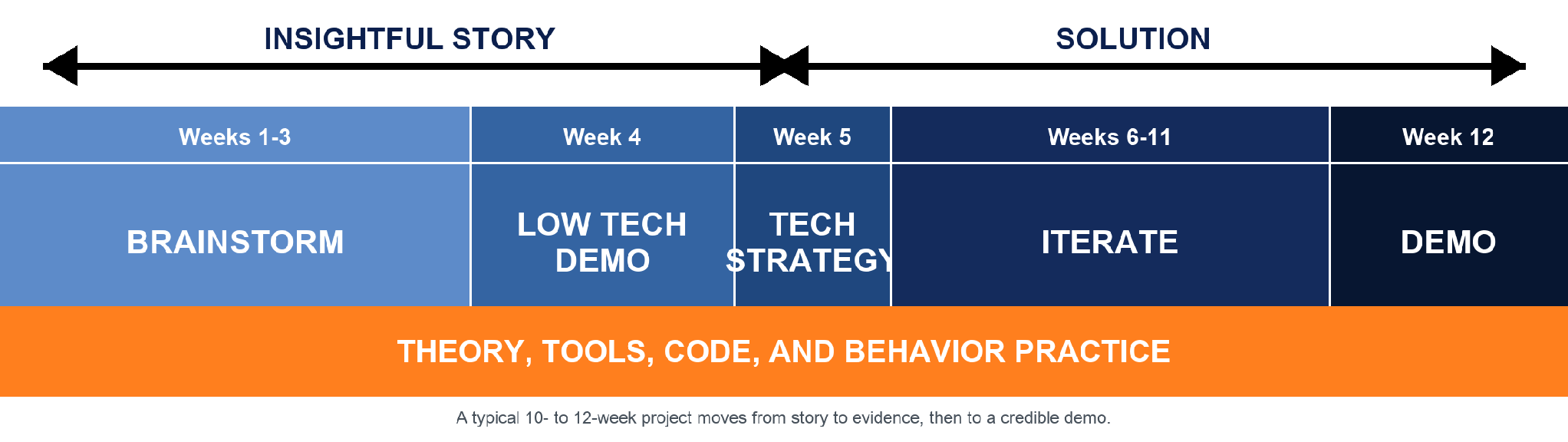
Figure 2A. A 10- to 12-week project method for combined technology, entrepreneurship, and design work.
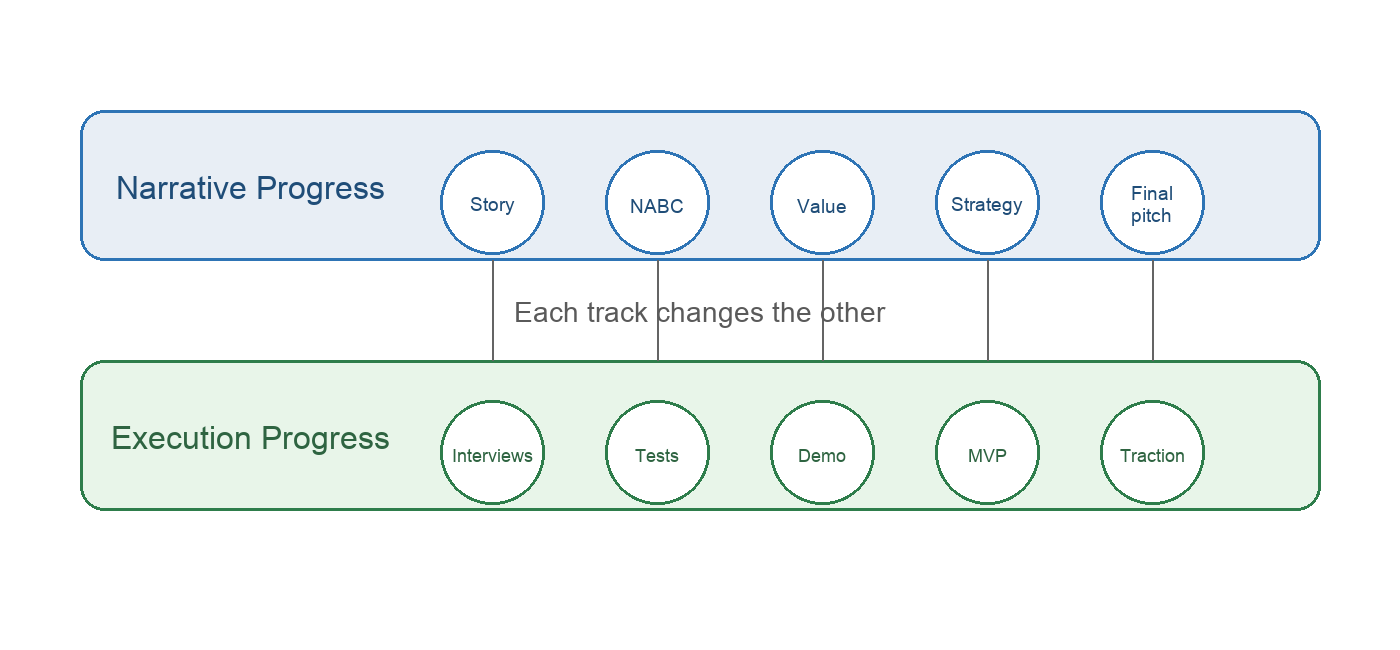
Figure 2. Story development and execution advance together.
Do not confuse activity with progress. A team that only builds may create something impressive but irrelevant. A team that only improves slides may sound convincing without proving anything. The strongest teams use the story to choose what to validate and build. Then they use validation and building to improve the story.
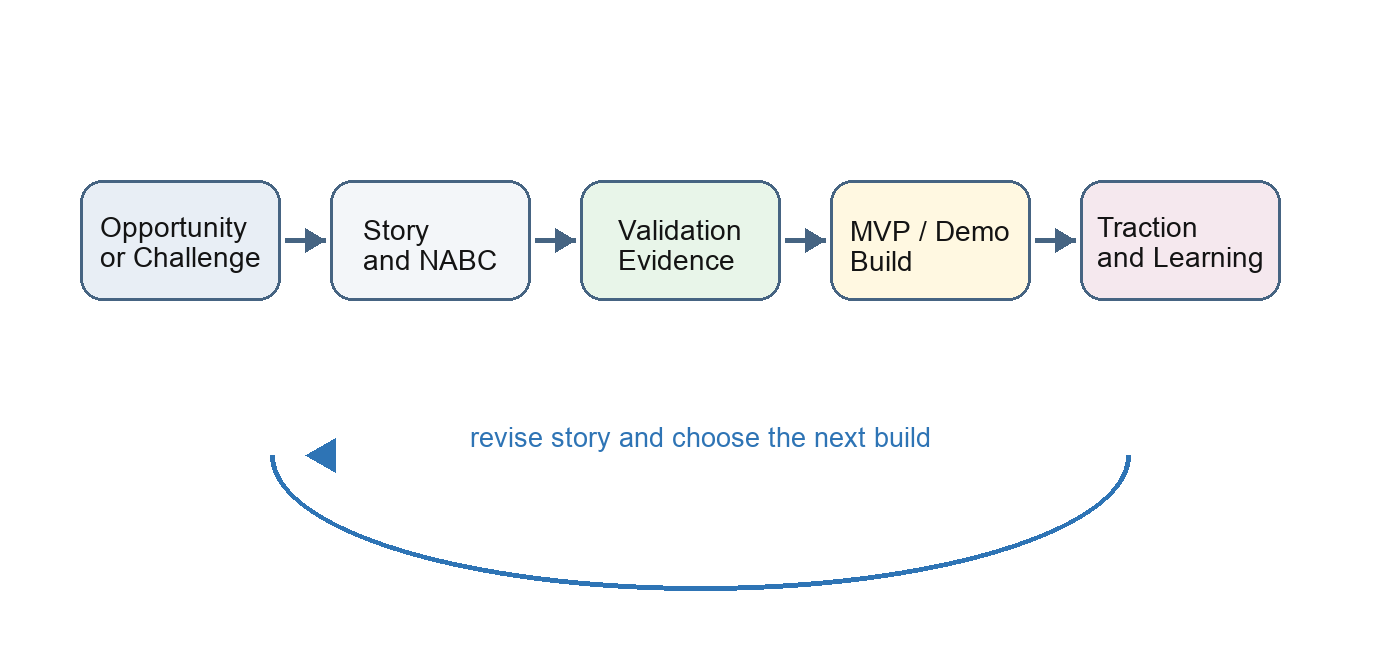
Figure 3. The IE 101 project loop.
Execution means moving the project toward proof. Proof may include a validated problem, a working demo, an MVP, a technical experiment, usage evidence, stakeholder interest, or a credible next-step plan.
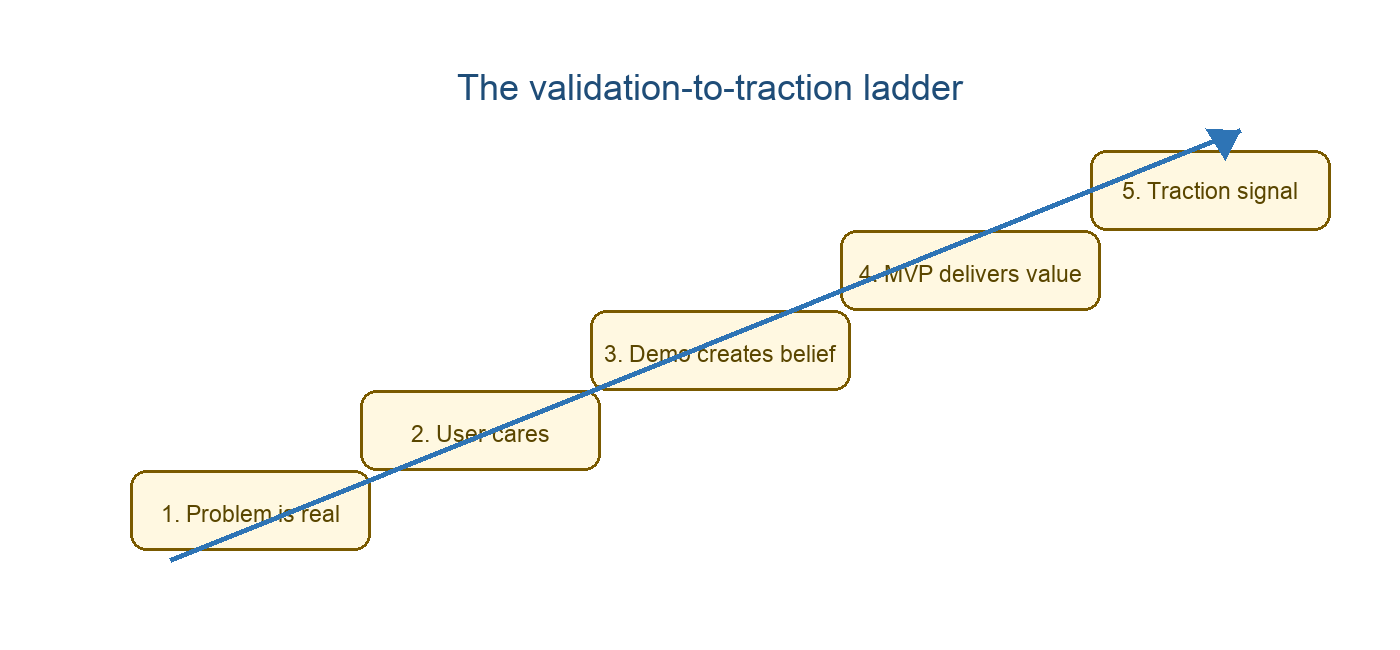
Figure 4. The validation-to-traction ladder.
CHAPTER 00 | ORIENT
Introduction: IE 101 and the Project Journey

| CHAPTER PURPOSE: Use this book to run a successful innovation or venture project class. The goal is simple: help students move from an uncertain idea to a stronger story, better evidence, a working demonstration, and a clearer next step. |
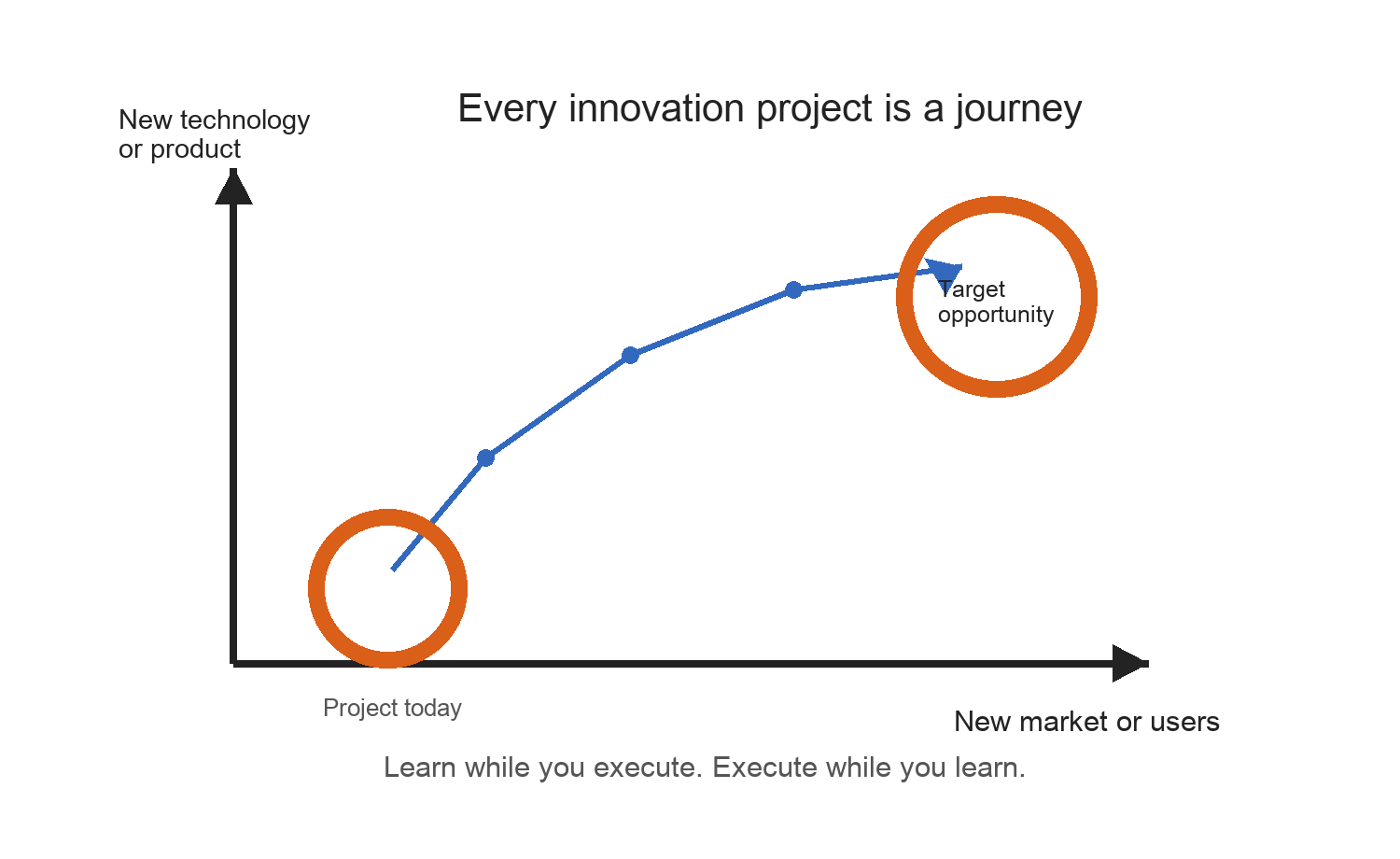
Figure 5. Every innovation project is a journey from today toward a target opportunity.
What this book is for
IE 101 is for courses where students must do innovation, not only discuss it. The course may be an entrepreneurship course, an innovation challenge, a company capstone, a technical venture studio, a research translation course, or a practically oriented science and technology project class. The book gives the instructor a sequence. It gives the student a way to act.
Where the method comes from
The concepts in this book draw on 17 years of teaching, experimentation, research, and program development at UC Berkeley. That work included the Berkeley Method of Entrepreneurship, co-created and co-authored with colleagues, as well as Innovation Engineering, Data-X, engineering leadership programs, venture and challenge labs, and many industry-facing programs developed by Ikhlaq Sidhu and collaborators at Berkeley. The common lesson was direct: students learn innovation best when they work on real projects, receive feedback, build evidence, and change their thinking as they execute.
Why students and instructors can trust it
The material has been tested with Berkeley students, engineers, founders, executives, visiting scholars, and partner organizations. Programs connected to this work have involved companies such as Google, Yahoo, Amazon, Cisco, SAP, VMware, Samsung, and other technology firms, as well as universities and institutions including UC Berkeley, IE University, Lund University, the University of Jyväskylä, BI Norwegian Business School, Prague University of Economics and Business, Qatar Foundation, SRM, and others. This matters because innovation education should not be based only on opinion. It should be based on repeated practice across people, projects, and contexts.
The journey frame
Every innovation project is a journey. A team begins with what it knows today. It moves toward a target opportunity involving new users, new markets, new technology, or a new product. Good plans and smart teams can still fail because the path is uncertain. The course therefore uses a simple discipline: learn while you execute, and execute while you learn. Each week the team should improve the story and also produce evidence from customers, stakeholders, prototypes, demos, technical tests, or traction.
What the project must produce
The final output is not only a slide deck. A strong project produces a clear narrative, NABC, customer or stakeholder evidence, product design, a demo or MVP, learning from execution, and a credible next-step plan. In some courses the project may become a venture. In others it may become a capstone result, a research prototype, or a corporate innovation proposal. In all cases, the project should become more real each week.
Selected Background
The Berkeley Method of Entrepreneurship papers, co-authored with colleagues, describe entrepreneurship education as a holistic approach built around infrastructure, mindset, and tactics, with learning organized inductively through experience.
The original Innovation Engineering book organized these ideas into a practical framework for project execution, story development, innovation leadership, and technical behavior.
Data-X extended the approach into applied data science, AI, and venture-style projects, with students learning tools and concepts while building real projects.
IE 101 adapts these lessons for instructors who need a compact course text and project guide for 10- to 14-week innovation classes.
Program Background Cases
Sutardja Center at Berkeley
The Sutardja Center for Entrepreneurship & Technology at UC Berkeley became a practical laboratory for teaching innovation to engineers, scientists, founders, and technical leaders. The Center connected courses, venture projects, industry partners, executive education, and visiting scholars. It also provided the institutional setting in which the Berkeley Method of Entrepreneurship and related innovation leadership methods were co-developed, tested, and refined.
Data-X and X-Labs
Data-X showed how a technical course could teach tools and execution at the same time. Students learned data science, AI, and applied technology concepts while building projects with venture relevance. The model later influenced focused X-Labs in areas such as data, blockchain, and alternative foods. The lesson for IE 101 is direct: teach the concept, ask the team to apply it, then use the project result to improve the next concept.
From Berkeley to IE
The same project-first logic now informs work at IE University's School of Science and Technology. IE 101 uses IE as a play on words: Innovation and Entrepreneurship 101, and also a bridge to the author's current work as Dean and Professor at IE. The book is meant to be useful in Madrid, Berkeley, Silicon Valley, company capstones, challenge courses, and any classroom where students must learn by making an innovation more real.
Case Use
Use the Sutardja Center back story and Data-X as background examples. They show how project-based learning, technical work, entrepreneurship, industry connection, and mindset development came together in practice.
Practice Exercises and Questions
These exercises are intended as optional instructor assignments or reflection prompts. They should be selected according to the course length, project type, and maturity of the student teams.
What should a successful project class produce by the end of the term?
What evidence would convince you that the students learned through action?
What would be missing if the team only produced a polished slide deck?
Project Guide
This project guide translates the chapter into action. Students should use it to update their team evidence log, project narrative, product design, validation plan, and next build.
1. Identify possible areas of interest and personal learning goals.
2. List the skills, tools, contacts, or domain knowledge each student brings.
3. Establish the course expectation: every project must produce both a story and execution evidence.
Game-based Exercises: Orient
Choose one option, or assign two across consecutive class meetings. Each exercise should connect back to the team's current project evidence.
Name Badge
Why play: Students practice communicating identity, intent, and readiness before formal team formation.
Set-up: Give each student a blank name badge or card and markers.
Play the Game: Draw yourself on the badge without using only words. Then form groups of approximately 10 and explain what your design communicates.
Reflection Questions: What did others infer from your design? Which details communicated work ethic, creativity, or desire to participate?
Learn the Names
Why play: Teams experience attention, repetition, and trust as the first layer of collaboration.
Set-up: Groups of about 10 stand or sit in a circle.
Play the Game: Each person says their name. The next person repeats prior names in sequence before adding their own.
Reflection Questions: What helped you remember? How does remembering names connect to sales, interviewing, and team trust?
| WEEKLY EVIDENCE CHECK: Before moving on, the team should be able to answer four questions: What is clearer now? What has been proven? What has been built or tested? What evidence changed the plan? |
CHAPTER 01 | OPPORTUNITY
Starting with Opportunity, Challenge, Change, and Team

| CHAPTER PURPOSE: Choose a project of value. Form a team that can learn quickly. Start with a story, but do not confuse a story with proof. |
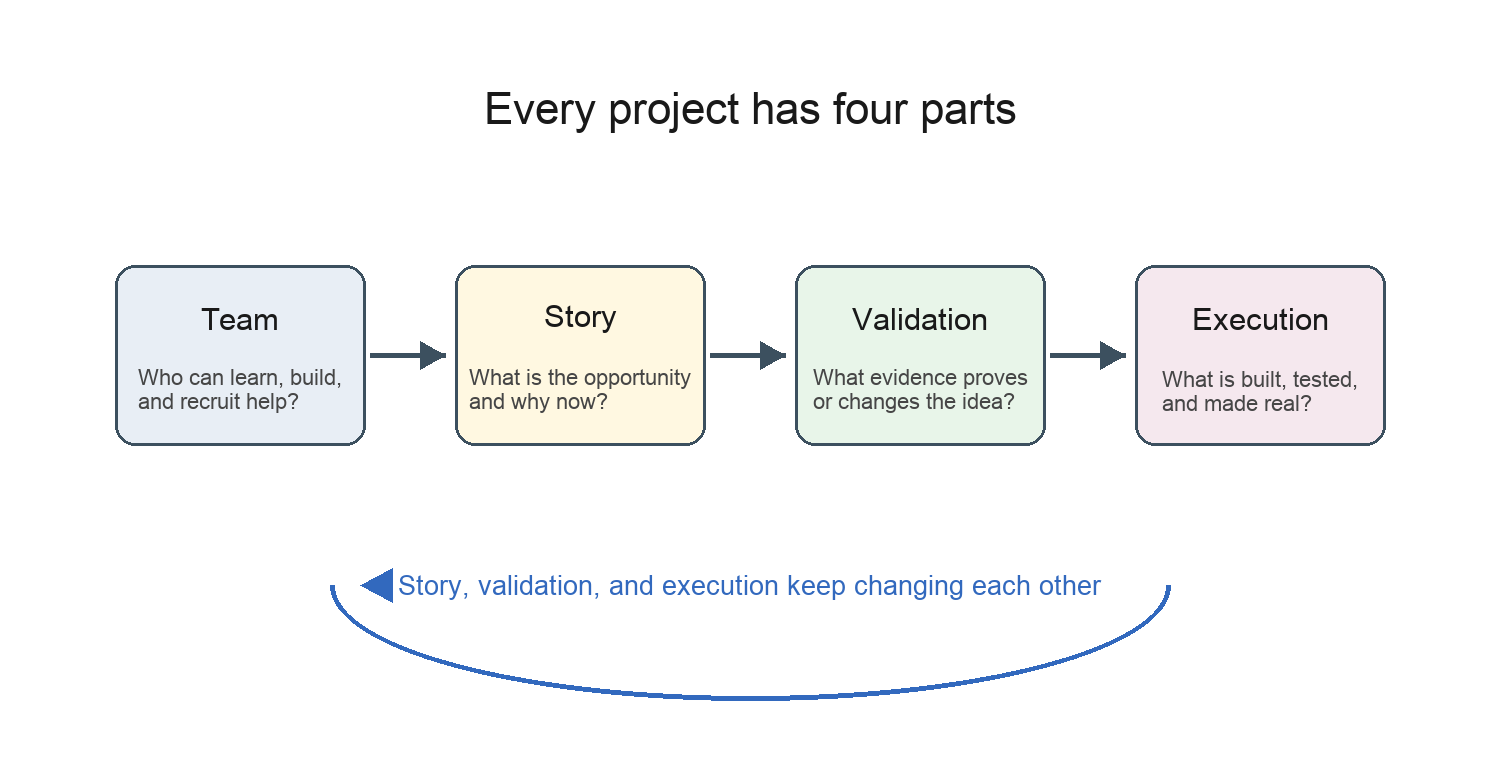
Figure 6. The four parts of any new project or venture.
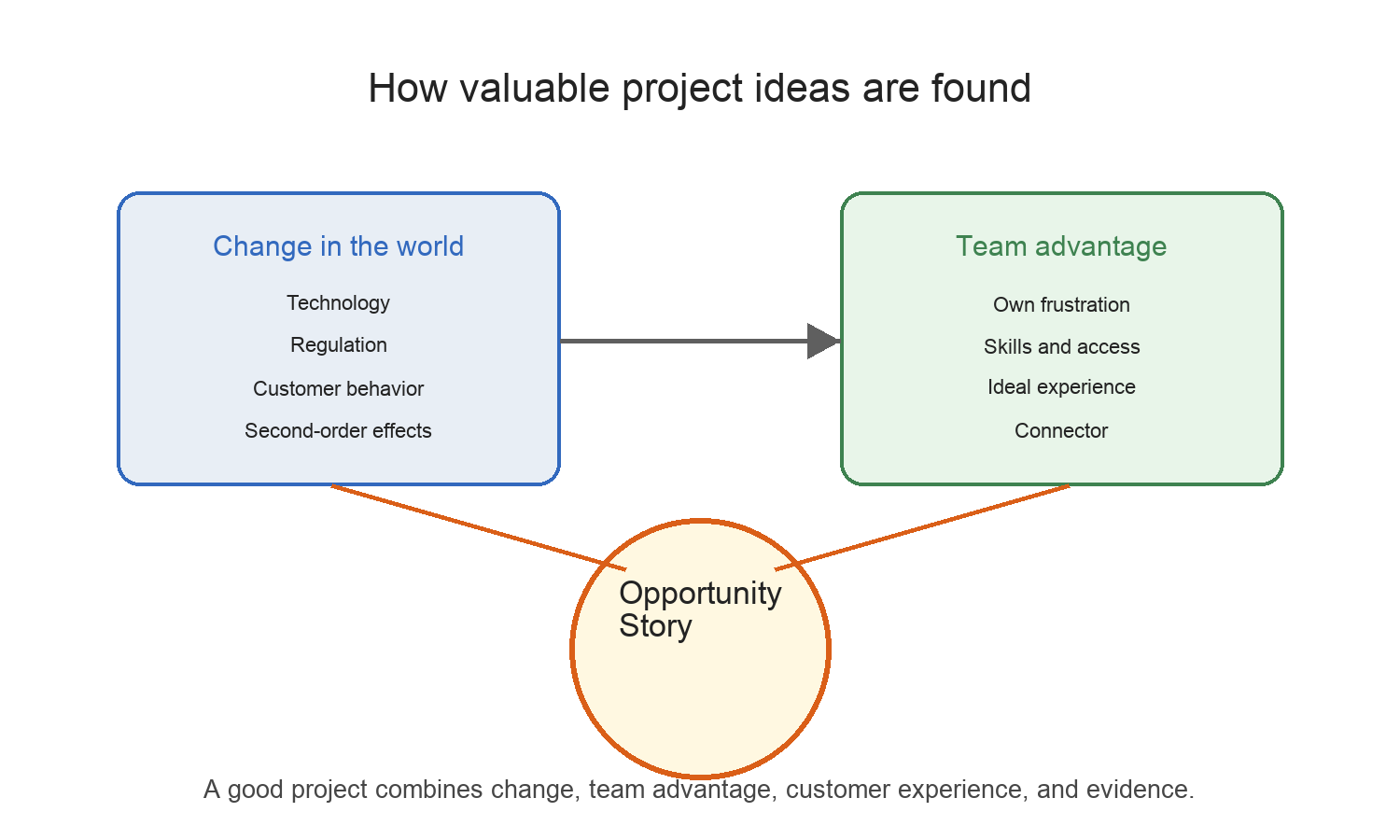
Figure 7. Valuable project ideas come from the intersection of change, team advantage, and evidence.
Every project has four parts
A new project has four parts: team, narrative or opportunity, validation, and execution. Most school projects spend too much time on the pitch and some time on team formation. That is not enough. IE 101 begins with team and story, but the course must quickly balance them with validation and execution.
Starting anything new
There is a standard model for starting new initiatives. First, develop an insight. Then build a story from change and from the team's capabilities. Then validate, adapt, and build an ecosystem of stakeholders. Only later should the project move toward operational scale. In the Berkeley Method of Entrepreneurship, this is the difference between Phase 1 and Phase 2. Phase 1 is learning and discovery of the business model at the lowest possible cost. Phase 2 is scaling with operations and measures.
The three-part solution
The path of an innovation project must be learned during its execution. The first part of the solution is a story that explains the opportunity. The second part is a disciplined process of validation and adaptation. The third part is execution that builds product, market, business model, sales process, and eventually operations. Do not rush to scale before the team has learned what should be scaled.
Choose a problem with value
A good project is not merely interesting. It has a reason to matter. Work on hard and large problems when the team can develop a monopoly of insight, skill, access, or speed. The project should be difficult enough to create learning and valuable enough that someone would care if the team succeeds.
Where opportunities come from
Opportunities often come from the intersection of change and team. Look for new technical capabilities, new regulations, new customer behaviors, new markets, new tools, or new constraints. Combine that change with what the team knows, can access, can build, or cares about deeply. The first story is the explanation of that intersection.
How to find an idea
Start with your own frustration and your own story. What do you know from direct experience? What problem keeps appearing? Where do you find yourself saying, there must be a better way? A personal frustration is useful because it gives the team energy, context, and an initial customer viewpoint. It is not enough by itself. It must still be tested with other people.
Pick a target to disrupt
Another way to find an idea is to pick a target: an incumbent, process, product, institution, or industry habit that could be made much better. Ask what the target does well, what it does badly, why customers tolerate it, and what change makes it vulnerable now. The point is not to complain about the incumbent. The point is to find a wedge where a new approach can win.
Design the ideal customer experience
Imagine the ideal customer experience without first accepting today's constraints. What should be faster, easier, safer, cheaper, more personal, more transparent, or more delightful? Then work backward. Which part can the team prototype? Which part can be tested now? Which part would create the strongest proof that customers care?
Look for automation and prediction
Many valuable ideas come from work that is repetitive, manual, slow, expensive, or judgment-heavy. Ask what could be automated, predicted, recommended, summarized, matched, routed, detected, or monitored. A useful AI or data project often begins here: find a decision or workflow where better prediction or automation creates a visible improvement.
Observe change, then ask what changes next
Look for change in technology, regulation, cost, behavior, distribution, demographics, climate, science, or culture. If the first-order opportunity is already obvious, it may be too late. Ask the second-order question: what will change next because this changed first? Then validate that implication. Do not assume the future. Test whether the next behavior, constraint, buyer, or need is actually emerging.
Use leading-edge users and connectors
Watch people who are already living in the future: expert users, extreme users, early adopters, researchers, operators, and communities at the edge of a new field. Also use the connector model. A connector, like Larry Bock in many science and technology communities, can bring top people in a new field together. One strong connector on a team can create access to customers, experts, partners, advisors, and early believers that would otherwise take months to reach.
Balance will and reality
Entrepreneurs need force of will, but force of will is dangerous when it blocks observation. Successful teams act, then look carefully at what the world tells them. Progress has two forms: technical and logical progress about the product, and social progress in the ecosystem of stakeholders. Technical experts often overbuild the first and underbuild the second.
What a good early project should show
The best early project has a simple economic logic. As Naeem Zafar and Mark Burgstone have often taught entrepreneurs, the best business looks like a mailbox that receives checks: add only what is needed to make the system work. For a class project, the equivalent is a clear path from user need to evidence, from evidence to product, and from product to a believable next step.
Case Use
Caviar can be used to show practical opportunity recognition: team background, industry interest, a failed first idea, and then a stronger opportunity discovered through customer behavior. Data-X and challenge labs can be used to show expert-framed starts, where students begin from a challenge and must learn the technical and market context quickly.
Practice Exercises and Questions
These exercises are intended as optional instructor assignments or reflection prompts. They should be selected according to the course length, project type, and maturity of the student teams.
Which of the four parts of your project is strongest today: team, story, validation, or execution?
What change in the world creates the opportunity?
What team capability, access, frustration, ideal customer experience, or connector gives you an advantage?
What could be automated or predicted in this domain?
What second-order effect of change might create a valuable problem?
Who are the leading-edge users or experts who already see the future before the mainstream market does?
What evidence would make this project worth continuing?
Project Guide
This project guide translates the chapter into action. Students should use it to update their team evidence log, project narrative, product design, validation plan, and next build.
1. Form teams around project topics, challenge areas, or opportunity stories.
2. Write the first opportunity story using change, team advantage, and one idea-finding method from this chapter.
3. Identify the first users, customers, stakeholders, or experts who can test whether the story is real.
4. Choose the first execution action: interview, observation, prototype, technical test, or simple demo.
Game-based Exercises: Opportunity
Choose one option, or assign two across consecutive class meetings. Each exercise should connect back to the team's current project evidence.
Classification Game
Why play: Students see how fast teams create categories, and how careful they must be to avoid shallow assumptions.
Set-up: Create teams of four and give them 10-15 minutes.
Play the Game: Team members introduce themselves, then classify the team into two or three nonjudgmental subgroups.
Reflection Questions: Which categories were useful? Which were too shallow? How should a project team classify customers without stereotyping them?
Trading Game
Why play: Opportunity recognition becomes visible when students must create value through action.
Set-up: Give each team of 3-4 a small starting item from the instructor.
Play the Game: Trade for greater value as many times as possible over 3-4 hours. Record each trade and why the other person accepted.
Reflection Questions: Where did value come from: story, convenience, relationship, scarcity, or creativity?
| WEEKLY EVIDENCE CHECK: Before moving on, the team should be able to answer four questions: What is clearer now? What has been proven? What has been built or tested? What evidence changed the plan? |
Introducing the First Case Study
In the section that follows after this page, we will look at the first case example of an innovation project or venture. As you read the short case, as well as future cases in this text, think about these questions:
1. Do the innovators/founders follow any particular process?
2. Where do they start and how do they proceed to narrow down the concept and then execute the project/venture?
3. Is there a particular style to the leadership of the project?
4. Are there behaviors and mindsets allow the team to be successful?
Looking at all the cases from this point of view will help you understand the framework of this book.
Case Study: Richard Din and Caviar
Bootstrapping a New Venture
Entrepreneur Richard Din launched Caviar in 2012. His goal was to provide a food-delivery service for dine-in restaurants that did not normally deliver. After just two years of operations, Caviar had employees and service in New York City, Seattle, Washington D.C., Los Angeles, and San Francisco. This rapid growth led to Caviar's acquisition by Square in August 2014 for more than $100 million. The services were later used by tens of thousands of restaurants across the United States.
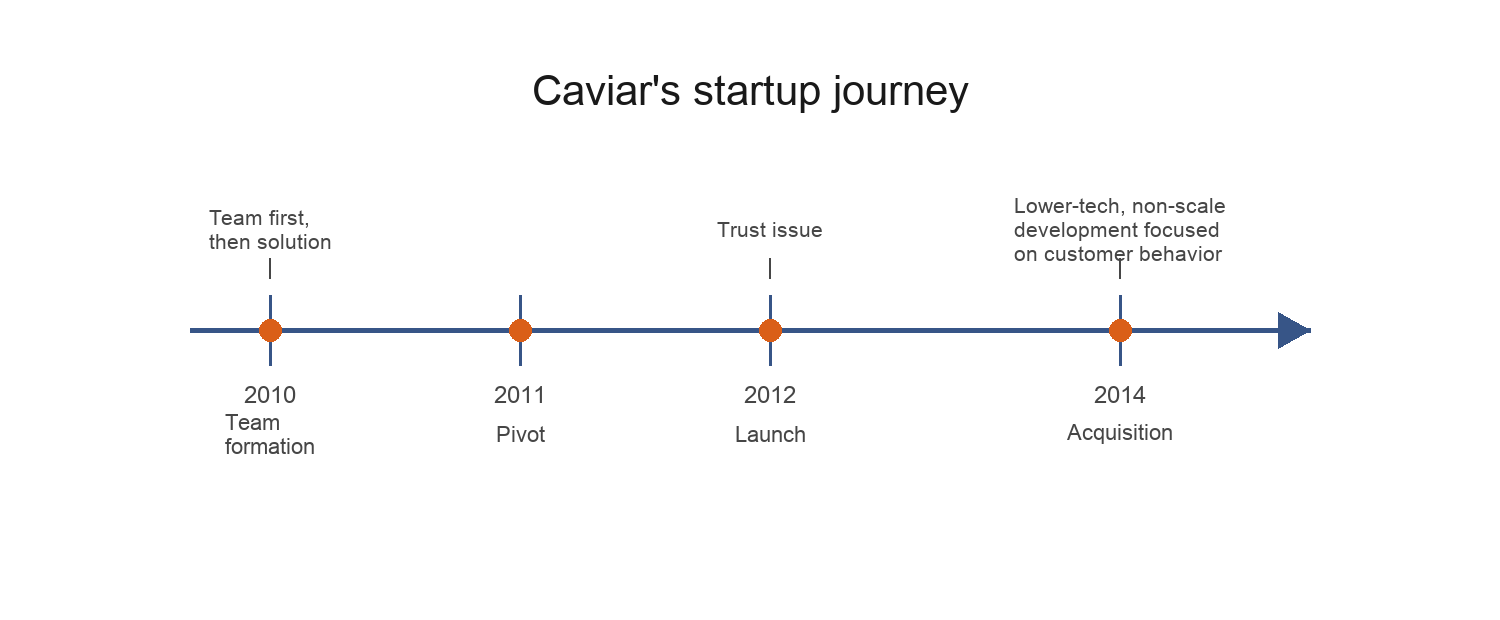
Figure 8. Caviar's startup journey.
The Initial Conditions
Richard Din was an electrical engineer by training and had worked at Electronic Arts after graduating from UC Berkeley. He began working with co-founders Tony Li, Andy Zhang, and Jason Wang, who were Berkeley students or recent graduates. Shawn Tsao and Abel Lin joined shortly afterward. The group came together first through shared interests. Only later did it settle on the food and restaurant industry.
| Team first. The team first came together, then agreed on a target industry, and finally selected the company's purpose. |
The team first tried a daily-deal food coupon concept. That idea failed quickly. The better opportunity came from a problem the team experienced directly: when they worked late together, they wanted food from high-quality restaurants that did not deliver.
| Passion is crucial. A team that cares about the problem has more energy to learn, persist, and notice what others miss. |
Story
The food-delivery idea was born from the team's own customer experience. They became their own first customers. The first story did not require a large platform or a sophisticated technology claim. It explained a simple change in customer experience: people wanted restaurant-quality food delivered, and restaurants wanted to serve those customers without building their own delivery operation.
| The initial story was the articulation of the business model. The rest was a demonstration of the product from the user's viewpoint. |
The Caviar team had two positive drivers: they wanted to use the service themselves, and they believed restaurants would be willing to outsource delivery if it did not distract from producing good food. With that story, the concept was ready to be tested in real life.
Service: Would customers beyond the team order delivery from high-quality restaurants?
Cost: Would customers pay a meaningful delivery fee?
Viability: Could the service work with existing restaurants and real orders?
Caviar's Use of Execution While Learning
The first challenge was to validate demand. In parallel, the team had to create enough technology to support the validation. Instead of building a comprehensive website, the team built the simplest possible interface, with one restaurant and one item that could be ordered. The purpose was to learn how customers behaved.
The back end was even simpler. A person received the order, called the restaurant, drove to pick it up, delivered it, and paid the restaurant later. The process was manual and not scalable. That was the point. The team was not yet trying to build the final system. It was trying to learn whether the customer experience and business scope were correct.
| Many projects go wrong because they focus on technology, scale, and high-quality implementation too early. At Caviar, the early service was intentionally manual so the team could learn from customer behavior first. |
Leadership and Innovation Behaviors
Trust became a major leadership issue. As the team grew, some early working relationships no longer supported the speed and quality required by the venture. The difficult decision to remove some early team members became important to restoring trust and execution speed.
| Trust appears as a key issue in the development of any team from the beginning. When trust toward a common objective cannot be restored, the team must act. |
Eagerness to Learn
According to founder Richard Din, the team's appetite for learning was critical. Without that eagerness, the rate of progress and execution would have been too slow.
Leadership Starts with Hiring
Caviar also treated hiring as a leadership function. By hiring well-rounded people, the company strengthened trust, technical skills, and innovative behavior across the organization.
| AUTHOR'S NOTE: This case emphasizes delaying technology and scale investment until user behavior has been validated during execution while learning. |
CHAPTER 02 | STORY
Developing a Better Story

| CHAPTER PURPOSE: Develop the first clear story for the project. By the end of this chapter, the team should be able to communicate at least an NABC version of the project in a clear, credible manner. |
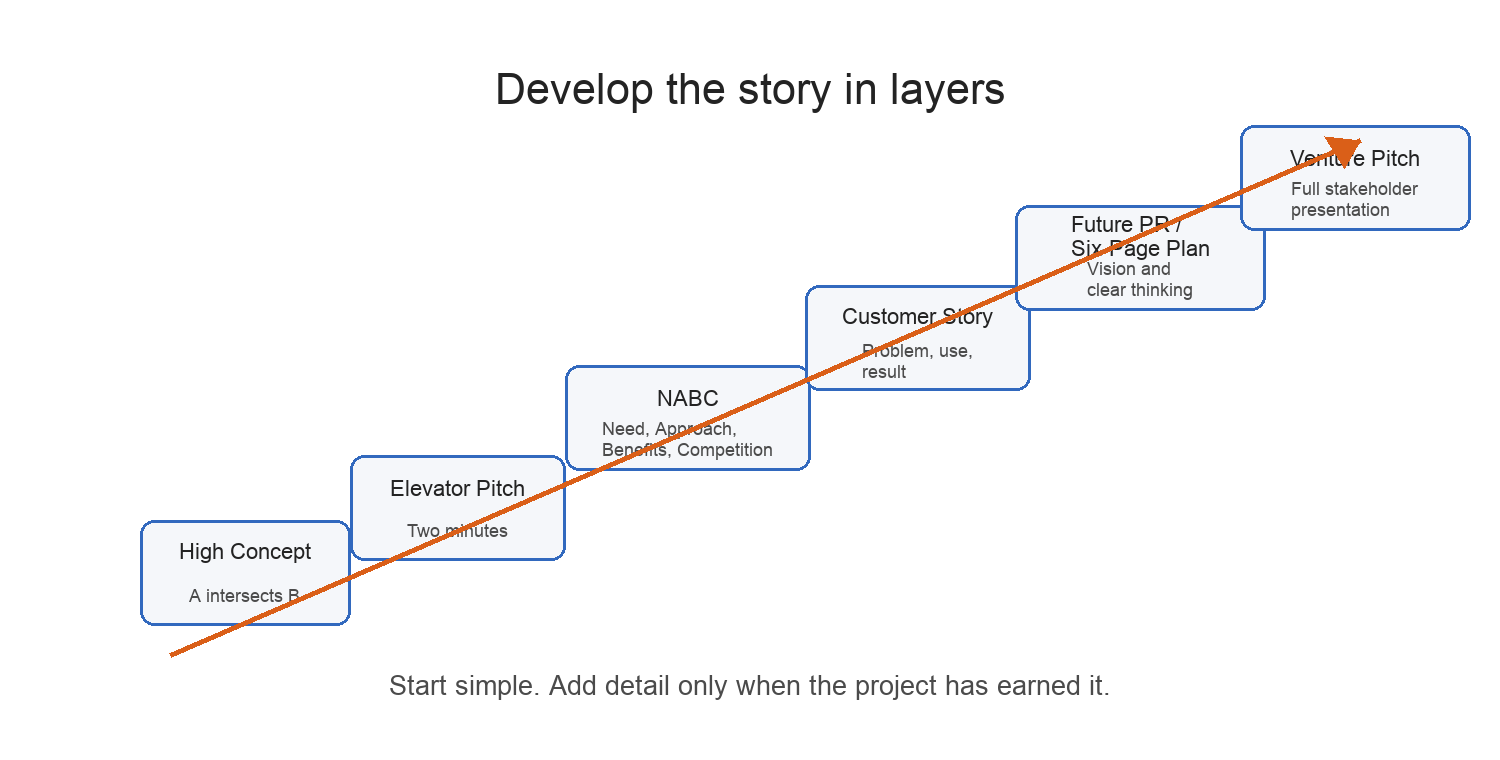
Figure 9. Develop the story in layers.
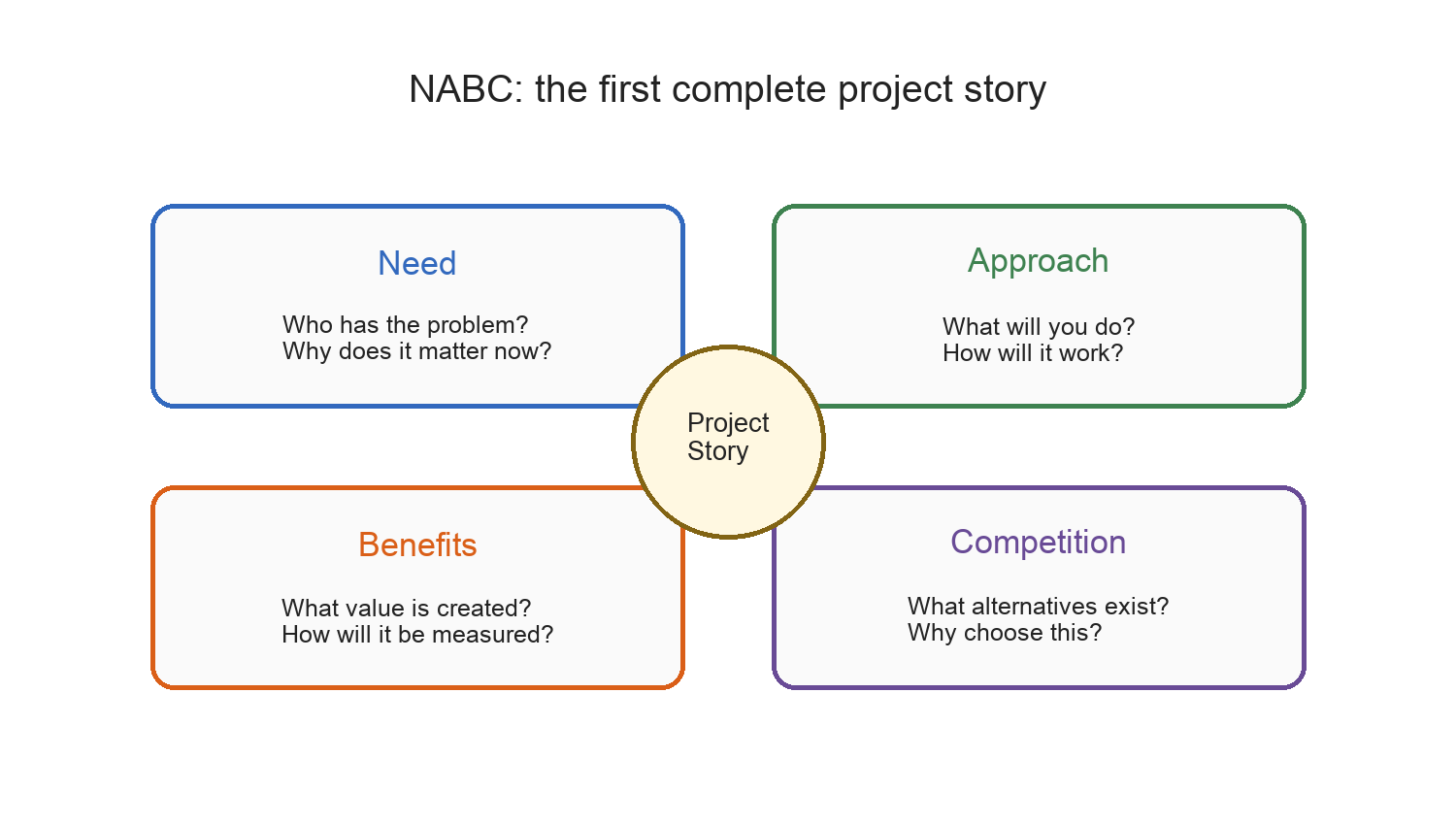
Figure 10. NABC is the first complete project story.
Story development
A story is not decoration. It is the working explanation of the project. It tells the team, customers, mentors, partners, and instructors what problem is being solved, why the moment matters, what approach is proposed, and what value may be created. The first version should be simple enough to say out loud and strong enough to invite feedback.
High concept pitch
The high concept pitch explains an idea by joining a known model with a new domain, market, or capability. It is the A-intersects-B form: Uber for food delivery, Amazon for a new geography, or Jaws in space. A high concept pitch is useful because it is fast. It is not enough because it usually hides the customer, the need, the evidence, and the competition.
| Example: A high concept phrase might be 'Duolingo for lab safety' or 'TurboTax for grant reporting.' The phrase is useful only if the next sentence names the real user and need. |
Elevator pitch
The elevator pitch is a short spoken version of the story, usually two minutes or less. It should create attention and explain the problem, the proposed solution, and why the project matters. It may include a high concept phrase, but it should not stop there. A good elevator pitch should make the listener want to ask a useful next question.
The NABC model
NABC stands for Need, Approach, Benefits, and Competition. It is the first complete story model students should master. Need explains who has the problem and why it matters. Approach explains what the team will do. Benefits explain the value created. Competition explains the alternatives and why this approach should be chosen.
| Example: Need: students miss meals during late studio sessions. Approach: coordinate nearby restaurant pickup by project teams. Benefits: save time and improve food options. Competition: delivery apps, campus dining, or doing nothing. |
The customer story
The customer story shows how a user or customer experiences the product or service. It may look like a short commercial, product announcement, customer case, product demonstration, or mockup. It should make the use case memorable. The team should be able to say: this is the customer, this is the problem, this is what changes, and this is the result.
The future press release
A future press release is written as if the project has succeeded. It forces the team to describe the future outcome clearly. What would the headline say? Who would care? What problem would have been solved? What proof would make the result newsworthy? This format helps teams see whether their ambition is clear or vague.
The six-page plan
Amazon's six-page narrative memo is useful because full sentences expose unclear thinking. A six-page plan begins with context, explains the question or decision, compares approaches, states what is different, and ends with what matters for the customer, the organization, and the innovation. Students do not need a full six-page plan early, but they should learn the discipline behind it: write clearly enough that the thinking can be tested.
The venture pitch and its variations
The venture pitch is the longer stakeholder presentation. It often includes problem, solution, value proposition, market, product, business model, technology advantage, competition, team, financials, timeline, and ask. The same structure can be adapted for corporate projects, public service projects, technical initiatives, and capstones. The slides are not the story. The slides support the story.
Which story type should you use?
Start with the simplest story that creates useful feedback. Early teams should usually begin with a high concept pitch, elevator pitch, or NABC. After feedback, the team can develop a customer story, future press release, six-page plan, or venture pitch. Use the story type that helps the next stakeholder understand and respond.
Revenue and non-revenue projects
Not every project generates revenue directly. A public service, internal tool, research prototype, or company capstone may be judged by mission, adoption, user satisfaction, speed, cost reduction, risk reduction, or learning. The story still matters. Replace the business model with a mission model when needed: how does this project serve the organization or the people it exists to help?
Perfecting the story
The first story will have gaps. It may have missing evidence, too much detail, unclear benefits, weak logic, or a poor solution. That is normal. The story only needs to be good enough to start. It improves when the team tells it to credible stakeholders, listens carefully, collects feedback, and realigns the project.
Judging the story
A simple early test is Excitement, Logic, and Social power. Excitement asks whether people care about the story. Logic asks whether the story makes practical sense. Social power asks whether the team can attract stakeholders, partners, customers, and supporters. A project with a strong story should create energy, withstand questions, and recruit help.
Case Use
Use Caviar as a reminder that a practical customer story can precede sophisticated technology. Use Oracle later as an example of a story that changes how an enterprise understands a process.
Story Forms at a Glance
| High concept |
Create instant understanding |
One sentence: A for B, or A intersects B |
| Elevator pitch |
Start a conversation |
Two-minute spoken story |
| NABC |
Align the team and get feedback |
Need, Approach, Benefits, Competition |
| Customer story |
Explain the user experience |
Problem, solution, result |
| Future press release |
Clarify the desired future |
One-page imagined announcement |
| Six-page plan |
Force clearer thinking |
Written narrative with context, approaches, and customer value |
| Venture pitch |
Present to stakeholders |
Slides supporting the full project story |
NABC Working Draft
| Need |
Who has the problem, how strong is it, and why does it matter now? |
| Approach |
What will the team do, build, test, or change? |
| Benefits |
What value is created, for whom, and how could it be measured? |
| Competition |
What alternatives exist, and why should this approach be chosen? |
| The goal of this chapter is not a perfect pitch. The goal is a clear enough NABC to get useful feedback and choose the next validation step. |
Judging the First Story
| Excitement |
Do people care enough to lean in, ask questions, or offer help? |
1-5 |
| Logic |
Does the story make practical sense? |
1-5 |
| Social power |
Can the team attract customers, partners, advisors, and stakeholders? |
1-5 |
Practice Exercises and Questions
These exercises are intended as optional instructor assignments or reflection prompts. They should be selected according to the course length, project type, and maturity of the student teams.
Write a high concept pitch for your project.
Write a two-minute elevator pitch.
Write the first NABC: Need, Approach, Benefits, Competition.
Write a short customer story: problem, solution, result.
Score your story from 1-5 on Excitement, Logic, and Social power.
What part of the story is still vague, unsupported, or too complicated?
Project Guide
This project guide translates the chapter into action. Students should use it to update their team evidence log, project narrative, product design, validation plan, and next build.
1. Prepare a one-paragraph story and a two-minute spoken version.
2. Create an NABC slide for the project.
3. Create one customer story slide or sketch showing the user experience.
4. Pitch the NABC to at least three people and record what changed.
5. Revise the project story before moving into deeper validation.
Game-based Exercises: Story
Choose one option, or assign two across consecutive class meetings. Each exercise should connect back to the team's current project evidence.
Drawing Communication
Why play: Students learn that a story can fail even when the speaker thinks the instructions are obvious.
Set-up: Pair students back-to-back. One receives a simple drawing; the other receives blank paper.
Play the Game: The first student describes the drawing without showing it. The second recreates it. Compare results.
Reflection Questions: Which words created clarity? Where did assumptions enter? How does this apply to explaining a product?
Lego Instructions from an Architect
Why play: Teams experience the difference between expert intent and user interpretation.
Set-up: One student designs a simple Lego structure and writes instructions. Another team builds from the instructions only.
Play the Game: Build, compare, revise the instructions, and build again.
Reflection Questions: What was missing from the first version? How can teams test whether users understand the intended experience?
Introducing the Airbnb Pitch Deck Case
As you read the case, consider these questions:
1. How does the deck turn a simple travel frustration into an entrepreneurial story?
2. Which slide creates the strongest link between need, approach, benefits, and competition?
3. What should a student team borrow from this deck, and what should it avoid copying too literally?
Case Study: Airbnb Pitch Deck as Entrepreneurial Narrative
A compact story that made a new marketplace understandable
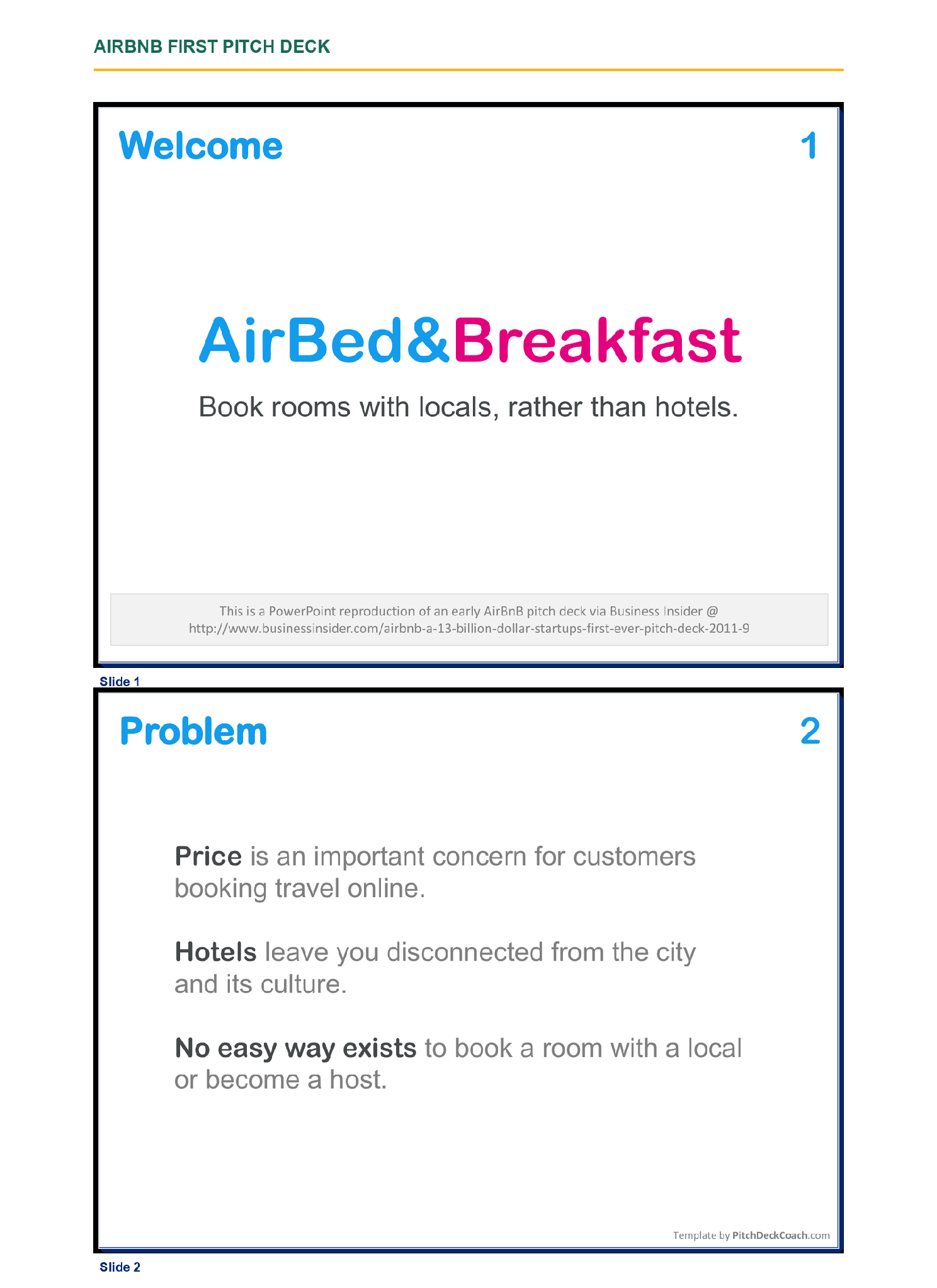
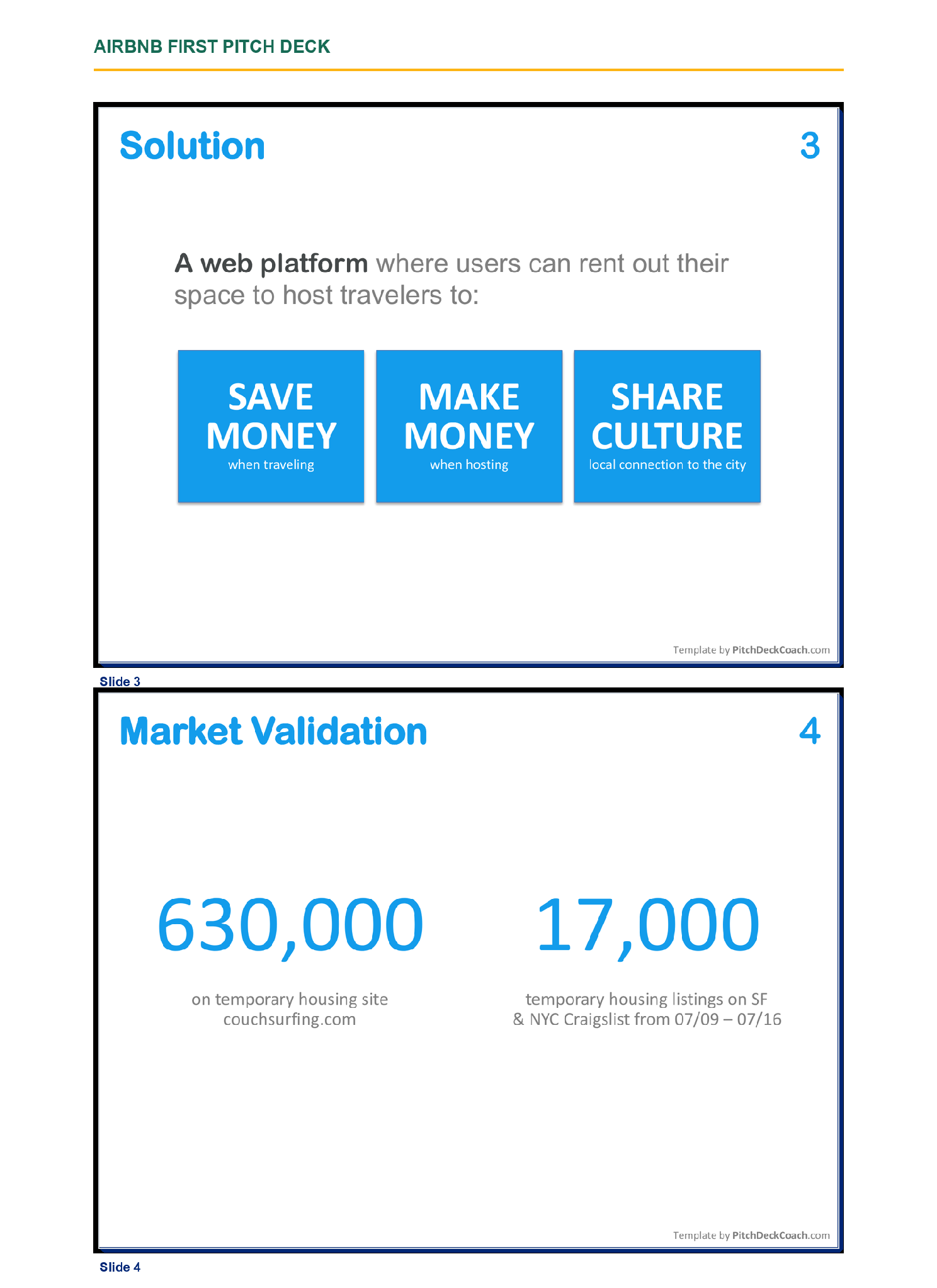
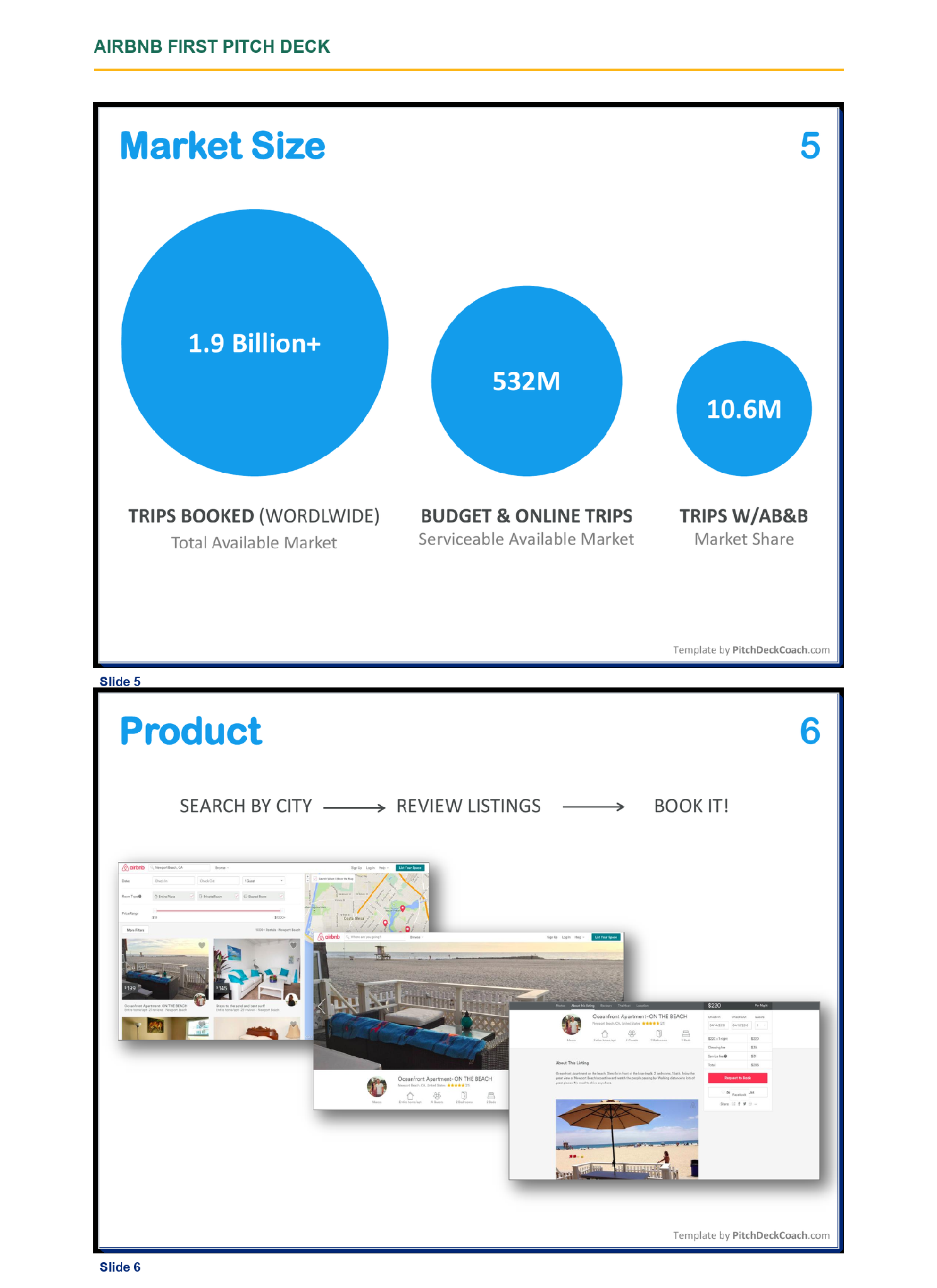
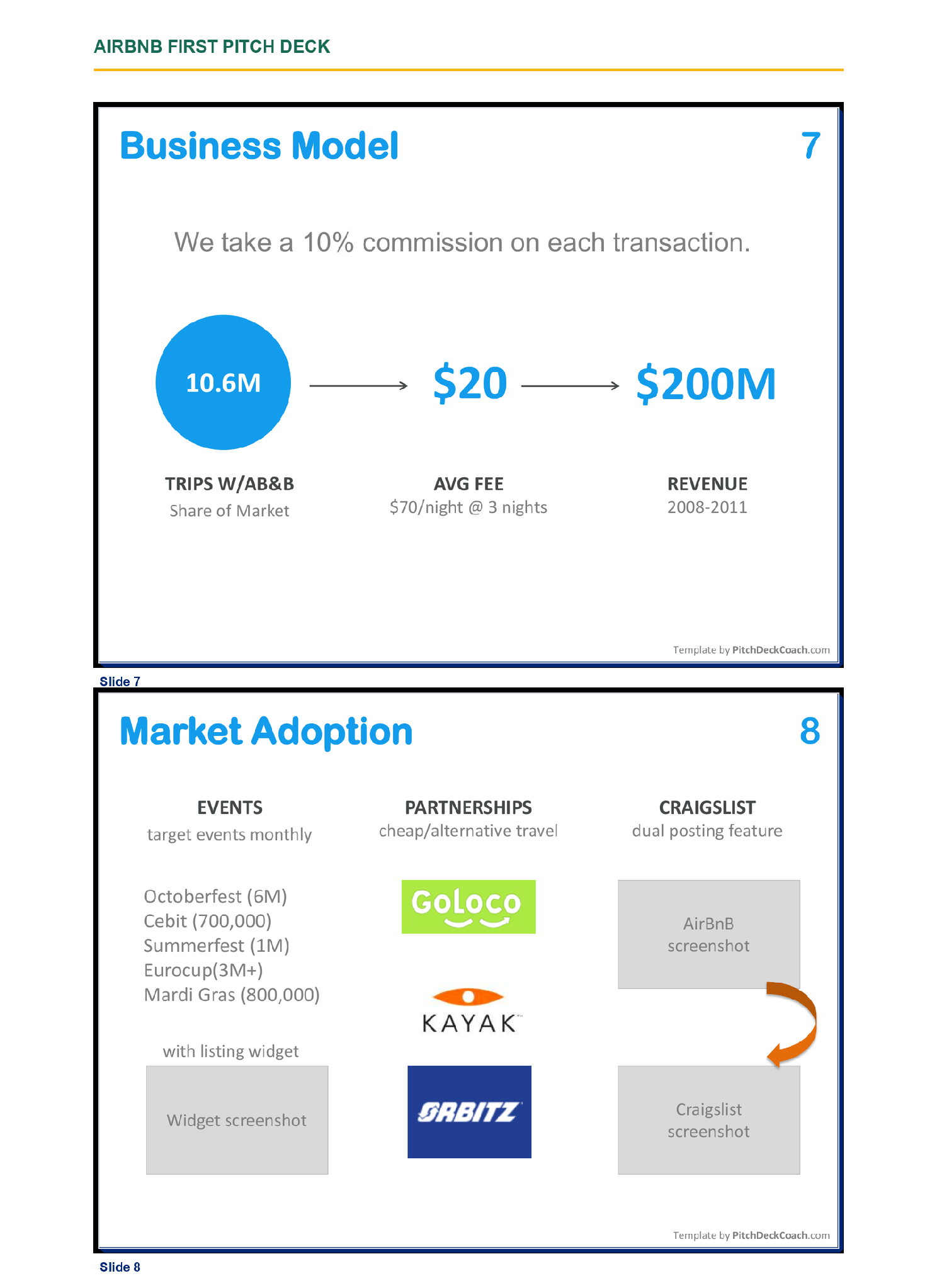
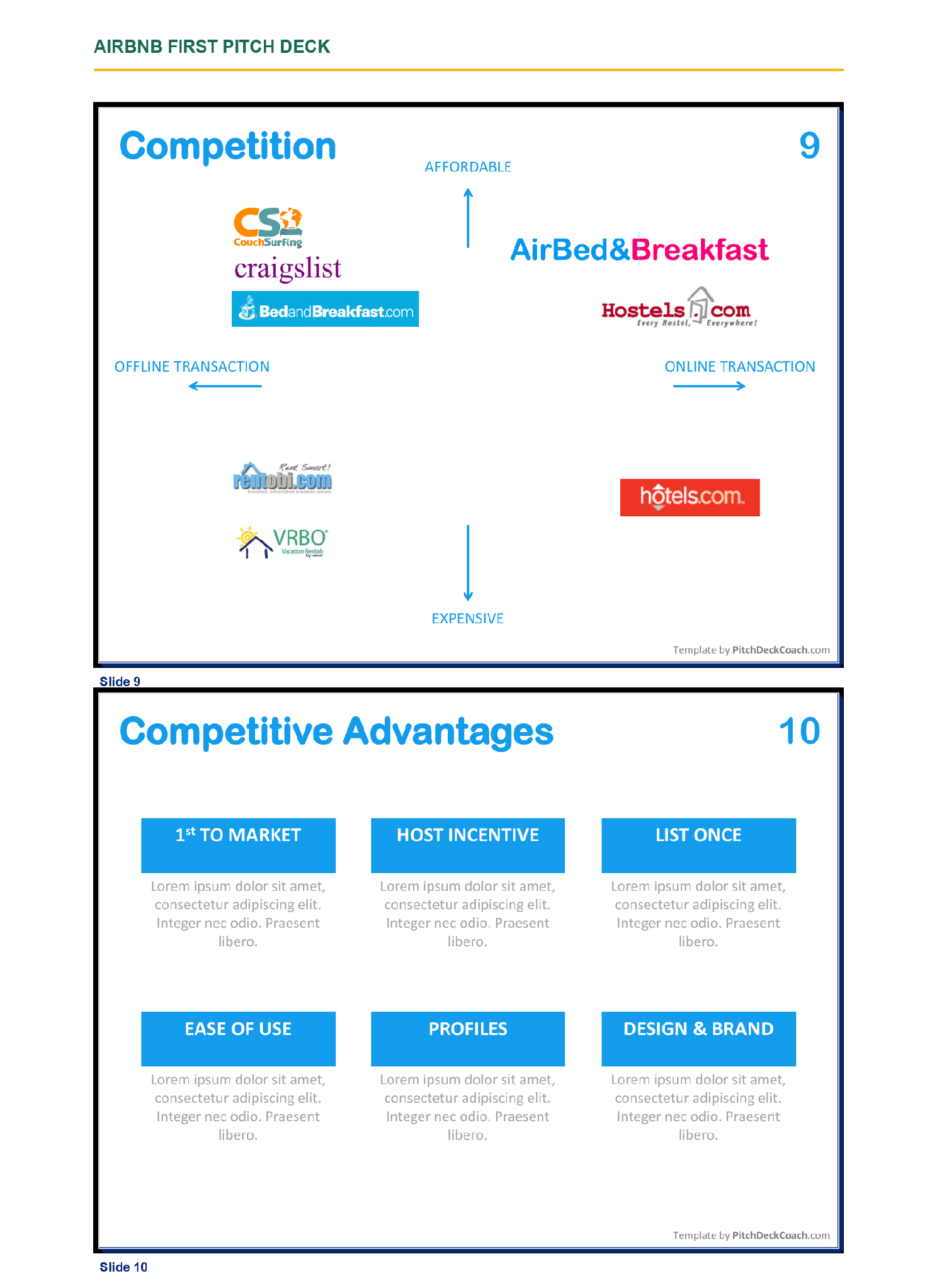
The early Airbnb pitch deck is useful in IE 101 because it shows how a venture can be explained without excess language. The deck moves from a plain problem to a plain solution, then adds validation, market size, product behavior, business model, adoption plan, competition, and advantages. For students, the lesson is not that every project needs to look like Airbnb. The lesson is that a project story becomes stronger when each slide answers one obvious stakeholder question.
Story Spine
The Airbnb narrative can be read as a sequence of claims:
Problem: travel is expensive, generic, and disconnected from local life.
Solution: people with spare space can host travelers through a web platform.
Validation: related platforms and local listings already show demand.
Market: the team translates broad travel activity into a reachable budget-travel segment.
Product: search, review listings, and book.
Business model: take a commission on transactions.
Adoption: use events, partnerships, and existing listing channels to seed supply and demand.
Competition: make the alternative set visible, then show the intended difference.
Why It Works as a Teaching Case
The deck is short enough for students to reverse-engineer. It also exposes the relationship between story and evidence: the claim is simple, but each following slide must make the claim more believable. The strongest feature is the order. It does not begin with technology. It begins with a human situation, then shows how the marketplace could work.
Case Questions
Rewrite the Airbnb story using NABC. What is the Need? What is the Approach? What Benefits are claimed? What Competition matters?
Which assumptions were still unproven at the time of the deck?
What would be the low-tech demo for Airbnb before a full platform existed?
How would the same deck change if the project were a non-revenue campus service, corporate innovation project, or research translation project?
Assignment: Remake the Narrative
Create a 10- to 12-slide version of your project story using the Airbnb deck as a structural reference. Keep each slide to one job: problem, solution, validation, market or mission size, product behavior, execution model, adoption path, alternatives, advantage, and next ask. Use only evidence the team has or can collect this week.
| Example: A student team building a campus equipment-sharing app might begin with one sentence: borrow specialized tools from nearby labs instead of buying or waiting. That sentence is not the whole story, but it gives listeners a hook. |
| WEEKLY EVIDENCE CHECK: Before moving on, the team should be able to answer four questions: What is clearer now? What has been proven? What has been built or tested? What evidence changed the plan? |
Introducing the Oracle Case
As you read the case, consider these questions:
1. How does this case change your view of where innovation can start inside a large organization?
2. What did the Oracle team learn only after turning the story into a working product demonstration?
Case Study: Oracle Changes Enterprise Procurement
Top-Down Led Innovation that Changed Supply Chains
Oracle entered business-to-business e-commerce at a time when enterprise purchasing still depended heavily on forms, faxes, requisitions, purchase orders, and slow coordination between companies. The case covers Oracle's early move toward cloud-based software and self-service purchasing, beginning around 1999.
| This case dispels the myth that innovation projects in companies are always organically created from the bottom of the firm. In many cases, the start-up within the larger firm is created by the top executive who provides the original idea, political cover, and guidance through the process. |
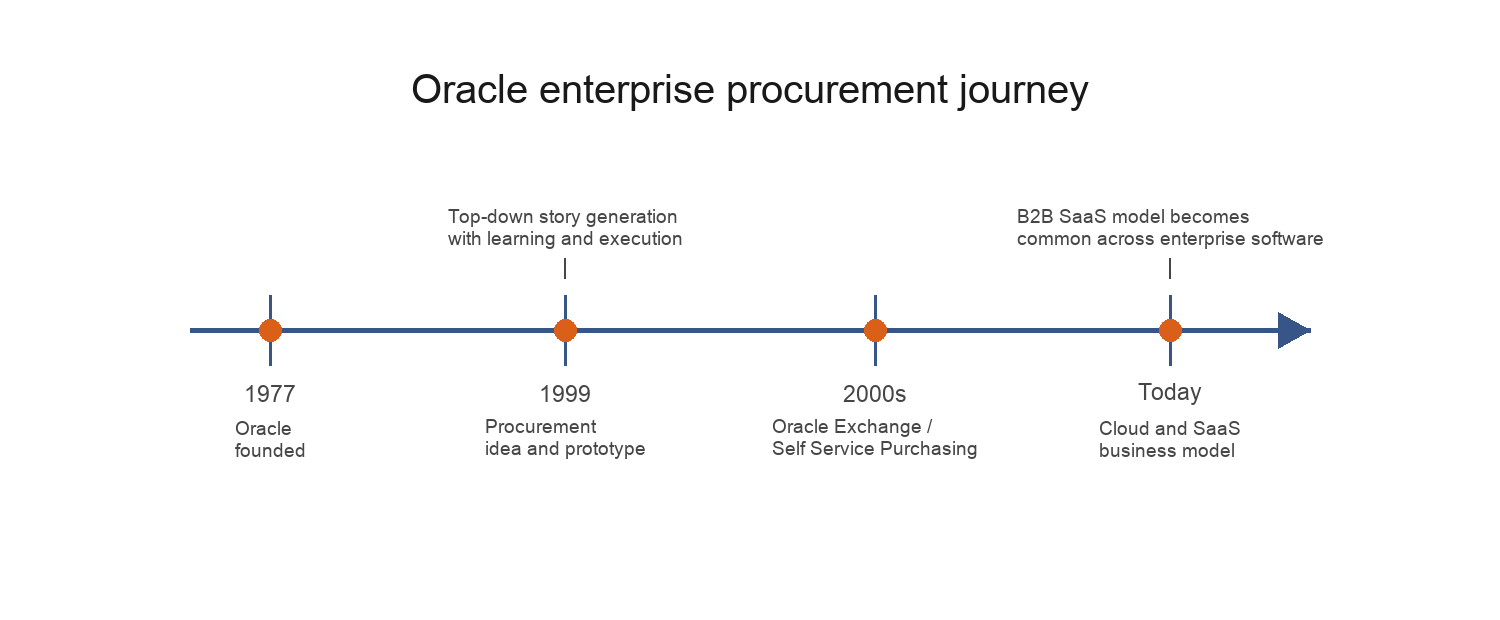
Figure 11. Oracle's enterprise procurement innovation path.
Initial Conditions
Larry Ellison had the concept that purchasing would be better if firms and suppliers could belong to a shared trading community. Any firm could log in and buy from other firms that also had accounts in the system. Since Oracle was a database company, it could host the website and the account and item data.
| Because Larry himself had developed the concept and insight around developing a trading community, it automatically provided political cover for the project. |
Story
The initial story was the high-level scope of a business model: Oracle would help create a trading community that made purchasing and supply chain management easier through the Internet. Once the team formed, the story evolved quickly into a product demonstration.
The team kept the focus on users and on a real demonstration. The product was tested internally and with selected customers, including GE. Over time, the product line became known as Oracle Exchange and Self Service Purchasing within Oracle's E-Business Suite.
Execution While Learning
Technical issues appeared as soon as the product was tested in live situations. For example, stateful web applications had to handle users pressing the browser back button during a purchase process. The team also learned to show status updates on screens so users always knew where they were in the process.
| Customer learning pushed the team toward consumer Internet patterns such as shopping carts and checkout, making enterprise purchasing feel simpler and more familiar. |
Behaviors
Open communication mattered. The team communicated continuously across roles and maintained a strong project rhythm. Context leadership was also important. A domain expert needed to understand purchasing, supply chains, retail, and the practical behavior of firms buying goods.
Summary
This is a sample case of top-down innovation led directly from the CEO. It shows that a start-up inside a firm can begin with executive insight, political coverage, a business-scope story, and a prototype that improves through execution.
CHAPTER 03 | DIAGNOSE
Common Strategic Errors and Story Narrative Mistakes

| CHAPTER PURPOSE: Improve the story by removing the mistakes that make projects sound weak, vague, naive, or disconnected from reality. |
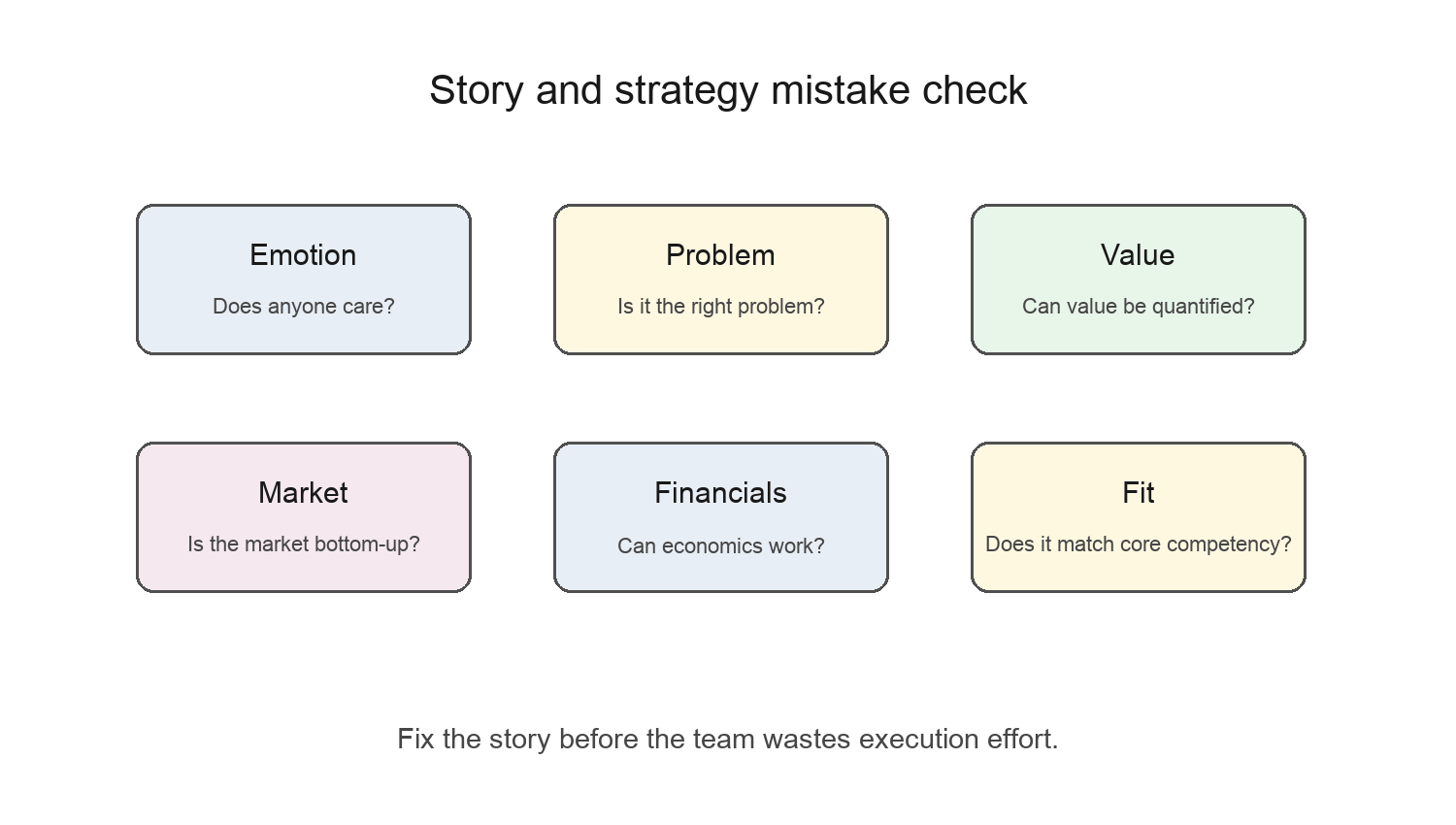
Figure 11. Common story and strategy mistakes to check before the next execution cycle.
What could possibly go wrong?
As a story becomes a fuller pitch, it will be evaluated, questioned, and challenged. The story does not need to be perfect, but it should avoid mistakes that waste time, weaken credibility, or send the team toward the wrong work.
Use the idea immediately. If it does not change the next interview, build, demo, decision, or pitch revision, it has not entered the project.
All logic, no emotion
A story can be logical and still fail because nobody cares. The problem should have human pain, urgency, frustration, or aspiration. The benefit should create energy. Without emotion, the listener is left with the question: who cares?
Use the idea immediately. If it does not change the next interview, build, demo, decision, or pitch revision, it has not entered the project.
Solving the wrong problem
Many teams solve a problem that customers do not actually have, or they validate a real problem but offer the wrong solution. The team must listen carefully enough to separate the problem it wants to solve from the problem customers actually need solved.
Use the idea immediately. If it does not change the next interview, build, demo, decision, or pitch revision, it has not entered the project.
Unquantified value proposition
A value proposition should eventually be quantified. What value is created? What is the next best alternative? How much time, cost, risk, effort, revenue, or satisfaction changes? If the value is large, the project has room to learn. If the value is small, the project has little room for error.
Use the idea immediately. If it does not change the next interview, build, demo, decision, or pitch revision, it has not entered the project.
Market size nonsense
Do not use a large market number just because it sounds impressive. Use the right market. Then estimate from the bottom up: who will buy or adopt, how many, how often, at what price or value, and in what realistic first period?
Use the idea immediately. If it does not change the next interview, build, demo, decision, or pitch revision, it has not entered the project.
Financial model errors
For revenue-generating projects, the team must eventually understand customer acquisition cost and lifetime value. If the cost to acquire customers is greater than the value those customers create, the model is broken.
Use the idea immediately. If it does not change the next interview, build, demo, decision, or pitch revision, it has not entered the project.
Core competency errors
Inside an existing organization, a new project must make sense relative to the organization's core competencies, assets, and strategy. If the project does not fit, the team must explain why the organization should still do it or why another organization is the right home.
Use the idea immediately. If it does not change the next interview, build, demo, decision, or pitch revision, it has not entered the project.
A final note on starting inside organizations
A proposal must be good enough that a management team can sponsor it, fund it, and protect it. The team should communicate the story, the competency fit, the customer or mission value, and the first execution path clearly.
Use the idea immediately. If it does not change the next interview, build, demo, decision, or pitch revision, it has not entered the project.
Case Use
VMware can be used as the main case for this chapter because it shows how technical logic, business story, market direction, acquisition, scale, and trust all interact.
Practice Exercises and Questions
These exercises are intended as optional instructor assignments or reflection prompts. They should be selected according to the course length, project type, and maturity of the student teams.
Where does your current story have logic but not emotion?
What evidence shows that you are solving the right problem?
What is the quantified value proposition?
What is the correct market or adoption calculation?
What core competency, asset, or partner makes the project credible?
Project Guide
This project guide translates the chapter into action. Students should use it to update their team evidence log, project narrative, product design, validation plan, and next build.
1. Revise the NABC to remove the most serious story mistake.
2. Add one quantified benefit or bottom-up market/adoption estimate.
3. Identify the next evidence needed to prove the problem, value, market, or organizational fit.
Game-based Exercises: Diagnose
Choose one option, or assign two across consecutive class meetings. Each exercise should connect back to the team's current project evidence.
Rejection Therapy
Why play: Students practice seeking real feedback instead of protecting a fragile story.
Set-up: Each student chooses a small, ethical request related to the project.
Play the Game: Ask someone likely to say no. Record what happened and what was learned.
Reflection Questions: What did rejection clarify? Did the request fail because of the idea, the ask, the audience, or the timing?
Videotape the Ask
Why play: Students make their pitch behavior visible.
Set-up: Use a phone camera and a one-minute request.
Play the Game: Record one rejection, one acceptance, or the largest reasonable ask that receives acceptance.
Reflection Questions: What changed when the ask was specific? Where did confidence, clarity, or listening affect the outcome?
| WEEKLY EVIDENCE CHECK: Before moving on, the team should be able to answer four questions: What is clearer now? What has been proven? What has been built or tested? What evidence changed the plan? |
Introducing the VMware Case
As you read the case, consider these questions:
1. What changed when VMware moved from technical promise to market-scale execution?
2. Why did scaling require not only technology, but culture, trust, and platform discipline?
Case Study: VMware Scaling Innovation in Mobile
VMware Scaling Mobile Device Management
VMware was one of the first commercially successful companies to virtualize the x86 architecture. This case starts with VMware's effort to move toward mobile virtual platforms and then shows how the company scaled through acquisition, integration, and engineering discipline.
| An innovation project may start within one team or approach, but then move to scaled execution using an acquisition. |
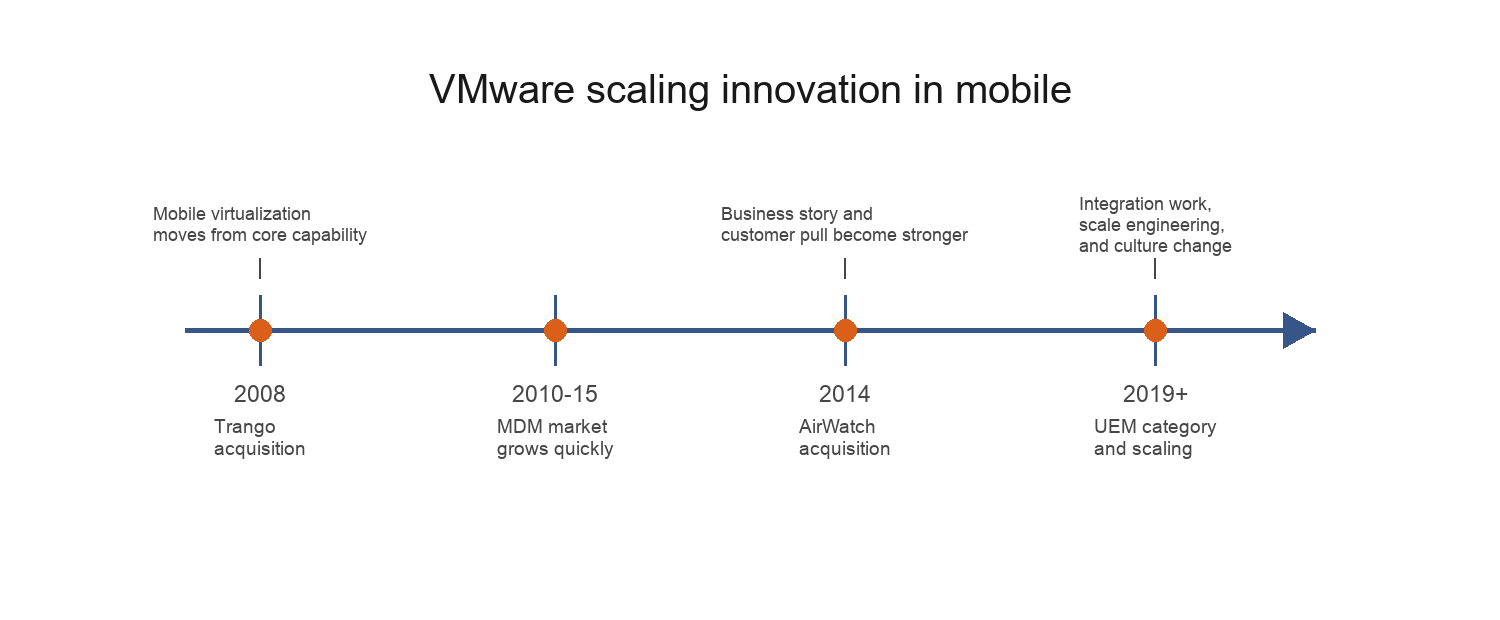
Figure 12. VMware's mobile innovation and scaling path.
Initial Conditions
The case begins with VMware's acquisition of Trango in 2008 to extend its virtualization capability onto mobile devices. At the same time, the market moved toward Mobile Device Management, where enterprise apps and data could be managed securely on employee devices.
| TECHNICAL NOTE: Mobile Device Management and mobile virtualization offered related benefits, but the market adopted a different technical approach than the first VMware mobile virtualization path. |
Story
VMware's original story was an A x B model: virtualization applied to the growing mobile market. The technical demo was compelling, but the business story and organization had not developed enough. AirWatch had the opposite strength: a compelling contextual story about enterprise customers needing personal and professional mobile identities on the same device.
| The AirWatch business story was well developed, but the scalability of the technology was not. The core VMware organization was well suited to aid in this next phase of growth. |
Execution While Learning
After the acquisition, VMware teams joined the AirWatch team to strengthen the business. The work had start-up speed, but it also required enterprise-grade engineering infrastructure. Security capabilities had to be strengthened, vulnerabilities closed, and the product made ready to scale.
Behaviors
Scaling means the product works not only for one user or ten users, but for hundreds, thousands, millions, or more. That requires culture change. Early teams may be driven by sales and by changing the world. Later, teams must also be driven by making the product great and doing the disciplined work that makes systems reliable.
| Scaling is different than initial creation. It requires a culture change for the team, including an appreciation of experienced professionals, platform discipline, and leadership behaviors. |
Trust also becomes central during scaling. A new boss must earn the trust of a team that has already contributed, and marketing and engineering must believe in a genuine one-team approach. The leadership behaviors that helped VMware scale were transparency, openness, and collaboration.
CHAPTER 04 | BUILD AND TEST
Execution While Learning: Building, Testing, and Getting Traction

| CHAPTER PURPOSE: This chapter turns the project from a story into a cycle of evidence. The team should build, test, observe, revise, and repeat. |
Figure 13. Story and execution advance together.
Execution Is Not Only Building
Execution means moving the project toward proof. A team executes when it interviews a real user, runs a test, builds a demo, measures usage, secures a pilot, recruits a partner, or learns that an assumption is wrong. Building slides can support execution, but slides are not execution by themselves.
Build Only What Teaches the Next Lesson
The first build should be small enough to complete and clear enough to test. It may be a manual workflow, clickable mockup, data experiment, prototype, simulation, service trial, or working MVP. The question is not whether it is impressive. The question is whether it produces useful learning.
Figure 14. The project loop: build, test, learn, revise.
MVPs, Demos, and Traction Signals
A demo makes the project believable. An MVP creates useful learning with a real user or stakeholder. A traction signal shows pull from the world. At student scale, traction may include repeated use, sign-ups, pilot interest, a letter of intent, referrals, a technical benchmark, or a stakeholder asking for the next version.
Customer proof: someone has the problem and wants it solved.
Technical proof: the core function can work well enough to matter.
Value proof: the benefit is visible, measurable, or important.
Adoption proof: someone has a path to use, buy, sponsor, or support it.
Traction proof: the world pulls the project forward in some observable way.
The Weekly Execution Rhythm
Each week should produce evidence. The team should decide the highest-risk assumption, choose the smallest useful action, collect evidence, and revise the story and build plan. This rhythm prevents the project from becoming either a slide exercise or an unfocused build.
| The strongest teams connect story and execution every week. The story decides what to test. The test changes the story. |
Practice Exercises and Questions
What is the highest-risk assumption in the project right now?
What is the smallest build or test that could change the team's mind?
What evidence would count as traction at this stage?
What did the last build or test prove, and what did it fail to prove?
Project Guide
1. Define the Iteration 0 build target.
2. Run at least one user, customer, stakeholder, or technical test.
3. Record evidence in the project log.
4. Revise the NABC and demo plan based on what was learned.
Game-based Exercises: Build-Test
Choose one option, or assign two across consecutive class meetings. Each exercise should connect back to the team's current project evidence.
Drawing Communication
Why play: Teams test whether the updated story can be understood by someone outside the build team.
Set-up: Pair a project team member with a listener who has not seen the prototype.
Play the Game: Describe the demo flow verbally. The listener sketches what they think the product does.
Reflection Questions: Where did the listener's sketch diverge from the team's intent? What should change before the next demo?
Lego Instructions from an Architect
Why play: Students connect build instructions to product usability and demo reliability.
Set-up: Prepare a small Lego model or equivalent object with written build instructions.
Play the Game: Another team builds from the instructions only, then gives feedback on missing steps.
Reflection Questions: What did the builder need that the designer forgot to say? What does this reveal about your product instructions or onboarding?
CHAPTER 05 | EVIDENCE
Common Mistakes: Strategy, Story, Evidence, and Execution

| CHAPTER PURPOSE: This chapter helps teams find the weak spots in the project before demo-day pressure makes them harder to repair. |
Figure 15. Common story and strategy mistakes to check before the next execution cycle.
A Clear Story Can Still Be Wrong
Many teams believe that a clear pitch means the project is becoming true. That is a misconception. A team can speak clearly and still be solving the wrong problem. It can describe a large market and still have no adoption path. It can show a prototype and still have no evidence that anyone cares. The purpose of this chapter is to make the team harder on its own reasoning.
| CONTRAST: A polished story is a communication asset. Evidence is a project asset. The team needs both. |
The Most Common Mistakes
All logic, no emotion: the argument is rational, but no one feels urgency.
Solving the wrong problem: the team built around an assumption instead of the user's real pain.
Unquantified value proposition: the benefit is attractive but not measurable.
Market-size nonsense: the team uses a large top-down number instead of a believable bottom-up path.
Financial-model errors: the economics do not match the real selling, delivery, or operating model.
Core-competency errors: the project requires capabilities the team or sponsor does not have.
Evidence gaps: the team confuses activity, compliments, or slide polish with proof.
Diagnose the Evidence Gap
Before the next iteration, name the missing proof. Is the gap customer proof, technical proof, value proof, adoption proof, traction proof, or team-execution proof? A team that can name the gap can choose a better next action.
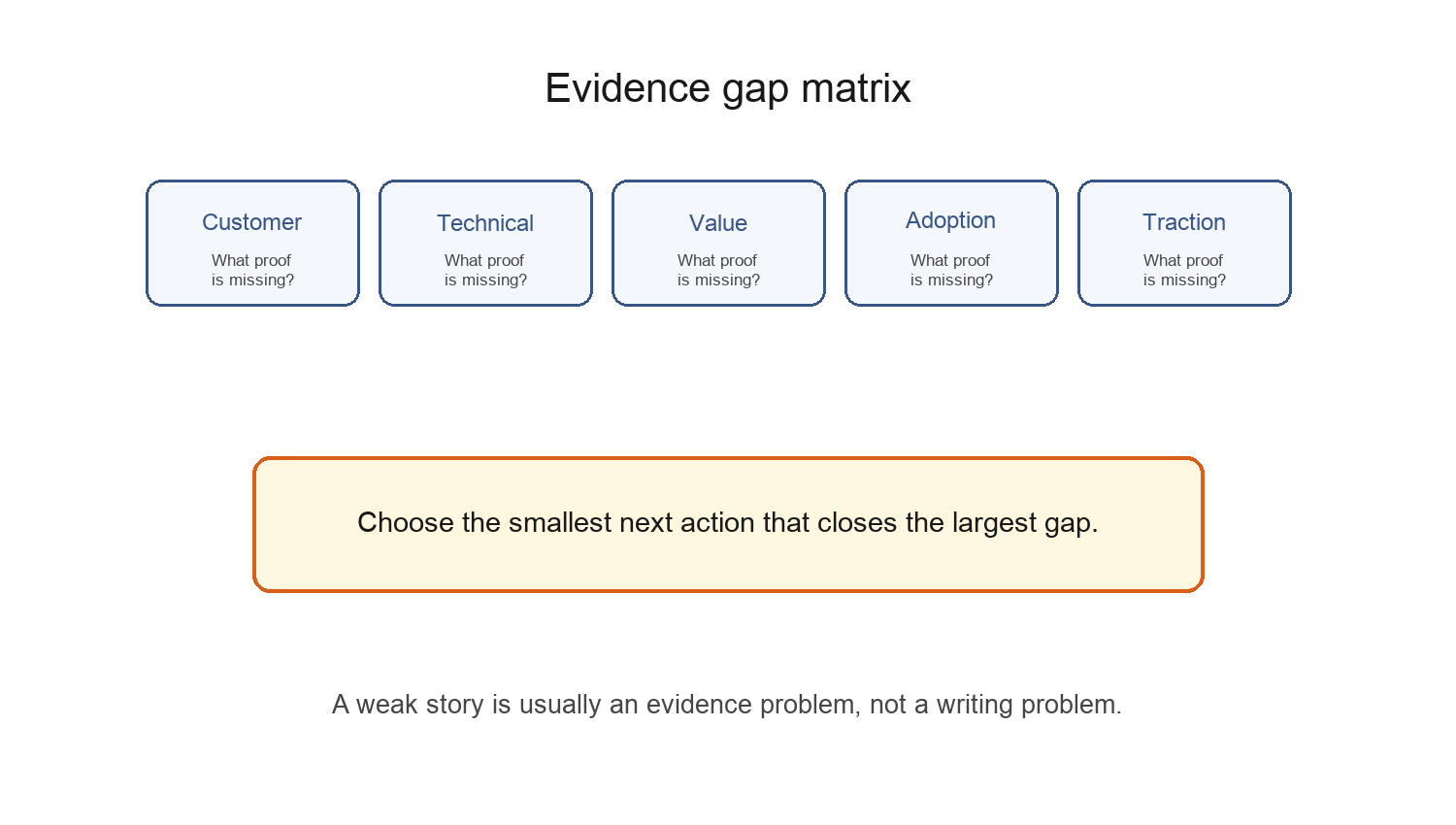
Figure 16. Use the evidence gap matrix to choose the next project action.
| Do not repair a weak story by adding more words. Repair it by finding the missing evidence. |
Example: The Friendly Interview Trap
A student team interviews ten classmates. Eight say the idea sounds useful. The team concludes that customer validation is strong. In contrast, a better test asks whether anyone has tried to solve the problem before, paid for an alternative, joined a waiting list, used a prototype twice, or introduced the team to a real buyer. Friendly interest is not yet traction. Behavior is better evidence.
Repair Before Scaling
The project should not scale until the team has resolved the most serious uncertainty. Scaling a weak assumption only makes the mistake more expensive. The practical discipline is simple: identify the largest risk, design the smallest useful test, and update the story honestly.
Practice Exercises and Questions
Where is the story overclaiming?
What is the weakest evidence in the current NABC?
Which assumption would an investor, sponsor, or customer challenge first?
What should the team stop doing because it is not producing evidence?
Project Guide
1. Mark the project evidence gaps by type: customer, technical, value, adoption, traction, or team.
2. Rewrite the weakest part of the NABC.
3. Choose one test or build that directly addresses the largest gap.
4. Prepare a revised 10- to 12-slide narrative only after the evidence plan is clear.
Game-based Exercises: Evidence
Choose one option, or assign two across consecutive class meetings. Each exercise should connect back to the team's current project evidence.
The Takeaway Game
Why play: Teams practice planning under constraints before investing more execution time.
Set-up: Use 15 coins and two players or two teams.
Play the Game: Play the simple version, then add a rule that increases complexity.
Reflection Questions: What changed when complexity increased? Which parts of the current project can be controlled by planning?
Rejection Therapy
Why play: Teams test whether evidence gaps are being hidden by politeness.
Set-up: Write one direct stakeholder ask tied to the weak assumption.
Play the Game: Make the ask and record the response.
Reflection Questions: What did the response reveal about urgency, value, or trust?
CHAPTER 06 | LEAD
Innovation Leadership

| CHAPTER PURPOSE: This chapter explains the leadership work required to keep an innovative team aligned, honest, and moving while the path is still uncertain. |
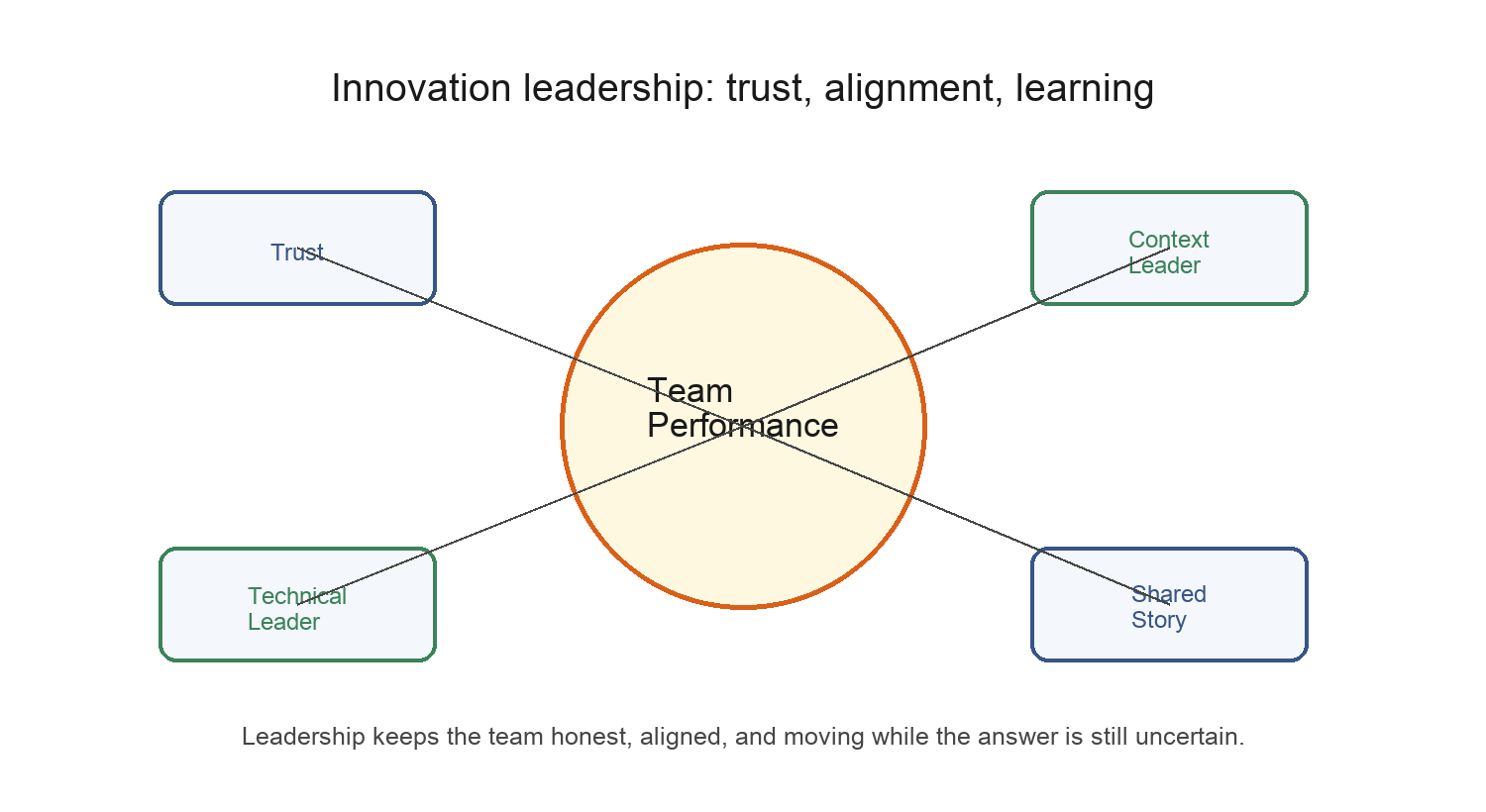
Figure 17. Innovation leadership connects trust, context leadership, technical leadership, and the shared story.
Leadership Begins with Trust
Many people believe leadership in a new project begins with vision. Vision matters, but this is incomplete. In an innovation project, leadership begins with trust: trust in integrity, trust in competence, and trust that team members will put the project ahead of personal ego when the evidence changes.
| CONTRAST: A charismatic leader can make people excited for a day. A trusted leader makes it possible for the team to tell the truth for months. |
Context Lead and Technical Lead
A strong project usually needs both a context lead and a technical lead. The context lead keeps the team close to users, customers, stakeholders, timing, value, and adoption. The technical lead keeps the team close to feasibility, architecture, implementation, risk, and proof. One person may play both roles for a short time, but the work is different.
| Example: In a climate hardware team, the context lead may own building-manager interviews while the technical lead owns the sensing prototype. Both must shape the same project story. |
| Context lead |
Keeps the project connected to the user, market, sponsor, and adoption path. |
The team builds something technically interesting but irrelevant. |
| Technical lead |
Keeps the project connected to feasibility, architecture, implementation, and measurable proof. |
The team tells a persuasive story that cannot be built or demonstrated. |
Example: Two Leaders in One Student Team
A health-tech team has one student who understands hospital workflow and another who can build the prototype. If the technical student dominates, the team may build a clever dashboard no nurse will use. If the context student dominates, the team may promise a product that cannot be implemented. Leadership means keeping both stories alive until they converge.
Planning, Urgency, and Agility
While many teams think agility means changing direction whenever a new idea appears, real agility is disciplined. The team sets a plan, tests it against reality, and changes only when evidence justifies the change. Urgency without learning becomes chaos. Learning without urgency becomes drift.
| A leader should ask each week: What did we learn? What did we build? What changed? What must happen next? |
From Growth to Alignment
As a project grows, leadership becomes less about inspiring the first action and more about keeping people aligned. New members, advisors, partners, and stakeholders create more capability, but also more noise. The leader must keep the project story, evidence, and next build visible to everyone.
Practice Exercises and Questions
Where does the team have strong trust, and where is trust fragile?
Who is currently acting as context lead? Who is acting as technical lead?
What conflict is the team avoiding because it feels uncomfortable?
What weekly rhythm would make the team more honest and faster?
Project Guide
1. Name the context lead and technical lead for the next iteration.
2. Write the next weekly evidence question before assigning tasks.
3. Hold one direct team conversation about trust, roles, and alignment.
4. Update the demo plan so technical work and customer learning support the same story.
Game-based Exercises: Leadership
Choose one option, or assign two across consecutive class meetings. Each exercise should connect back to the team's current project evidence.
Teamwork Lowest Score
Why play: Students experience shared accountability rather than individual optimization.
Set-up: Assign a short team task and explain that the team grade is the lowest individual score.
Play the Game: Complete the task, then discuss how the rule changed behavior.
Reflection Questions: Who helped whom? What did the team do differently when everyone carried the outcome?
Why play: Students practice presence and discomfort tolerance as leadership behaviors.
Set-up: Pair students and set a timer for 60 seconds.
Play the Game: Partners hold eye contact without speaking, then debrief.
Reflection Questions: What made the exercise uncomfortable? How does presence affect hard team conversations?
Introducing the Mixbook Case
As you read the case, consider these questions:
1. How did the Mixbook founders use customer feedback to move from the first yearbook idea toward a stronger opportunity?
2. Which leadership behaviors helped the company keep navigating innovation after the initial launch?
Case Study: Mixbook Navigating Innovation
Navigating Innovation Across Product Lines
Mixbook was founded by former UC Berkeley students Andrew Laffoon and Aryk Grosz. The company became an online design tool for customizable photo books, calendars, canvas prints, invitations, and cards. The case is useful because Mixbook did not only innovate once. It had to keep learning, adapting, and launching new product lines over many years.
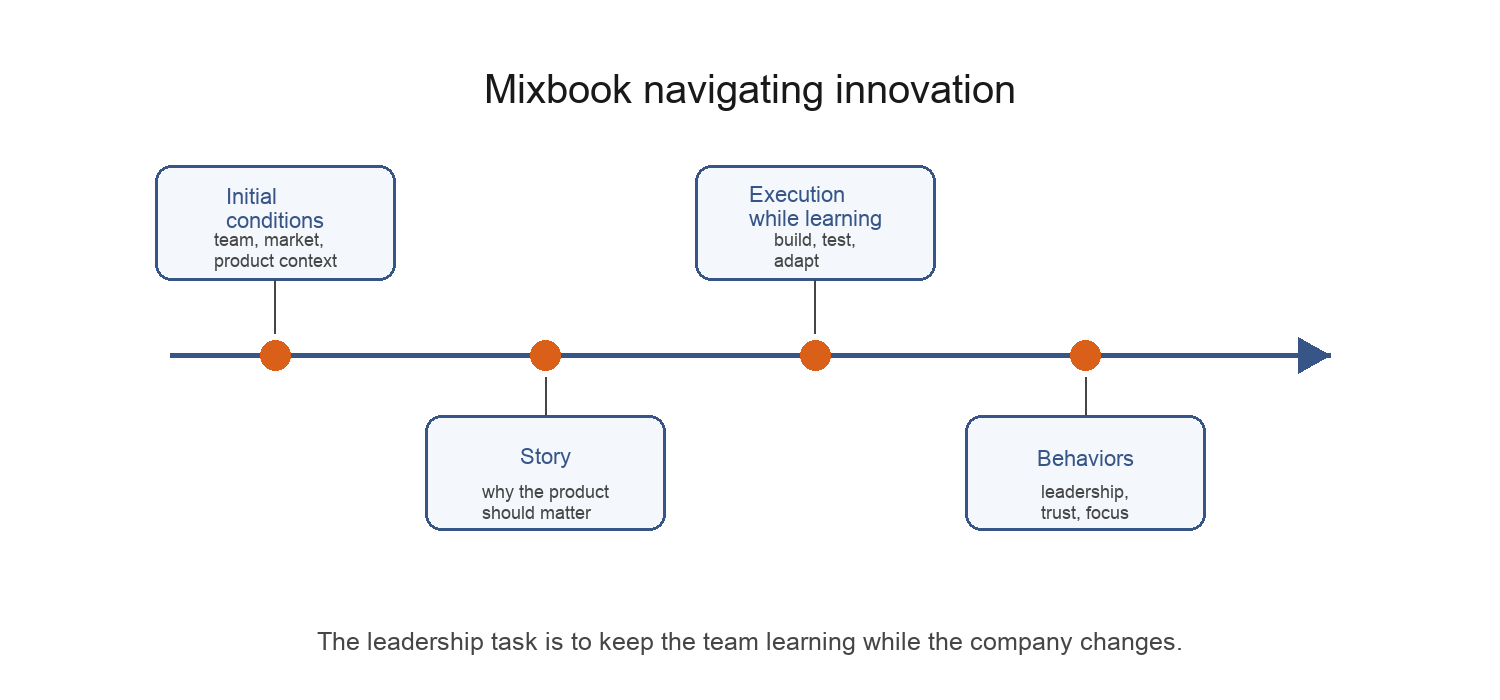
Figure 13. Mixbook's innovation journey.
Initial Conditions
The founders met through the UC Berkeley entrepreneurship environment and wanted to start a venture before they knew exactly what the venture would be. Their first concept focused on helping high school students self-publish yearbooks using editing software and print-on-demand capabilities.
| The team formed before the final opportunity was selected. This is common. The first task is to turn team energy into a valuable problem. |
When they met real school customers, the founders learned that the initial idea faced strong resistance. Schools already had yearbook processes, and administrators or teachers could block adoption. The team had to accept that the first story was not strong enough.
Story
The stronger story emerged by moving from a narrow school yearbook concept to a broader creative publishing and photo-product platform. The user story became less about replacing a school process and more about helping people design personal products with greater freedom and ease.
| A failed first story is not failure. It is evidence. The useful question is what the failed story teaches about users, buyers, adoption, and value. |
Execution While Learning
Mixbook improved through execution. The company learned from users, product launches, design tools, production workflows, and the economics of physical products. Each product line forced the team to connect the digital experience with print fulfillment and customer expectations.
| Execution reveals the real product. In a company like Mixbook, the product is not only software. It is the complete experience from design to delivery. |
Behaviors and Mindsets
The case emphasizes persistence, team trust, customer attention, and willingness to adjust the story. The founders had to maintain enough conviction to continue and enough humility to change direction when evidence required it.
| Innovation leadership is the ability to keep the team moving while the project is still uncertain. |
CHAPTER 07 | CULTURE
Culture, Mindset, and Behavior

| CHAPTER PURPOSE: This chapter explains how individual mindsets become team behaviors, and how repeated behaviors become innovation culture. |
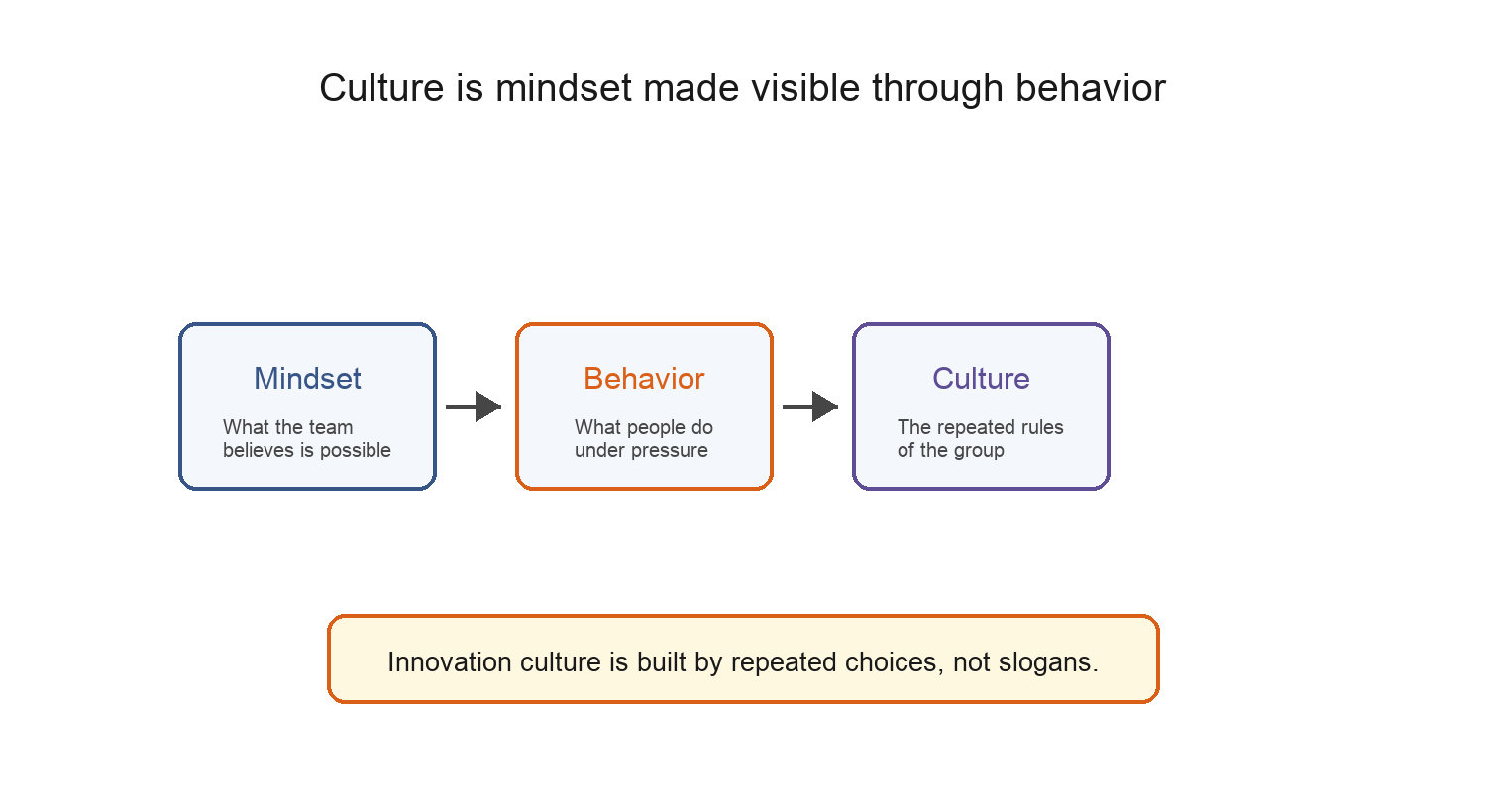
Figure 18. Culture is mindset made visible through behavior.
Culture Is Not a Slogan
Many organizations talk about innovation culture as if it were a list of values on a wall. That is a misconception. Culture is what people repeatedly do when there is uncertainty, pressure, disagreement, and incomplete evidence. In a course project, culture is visible in how the team handles feedback, conflict, deadlines, and disappointment.
| CONTRAST: A team does not have an innovation culture because it says it is creative. It has an innovation culture when it repeatedly learns, adapts, and helps each other execute. |
Behaviors That Support Innovation
Storytelling: turn scattered facts into a narrative people can understand and improve.
Trust: make it possible to say hard things early.
Comfort-zone expansion: practice doing useful things that initially feel unfamiliar.
Accretive negotiation: look for ways to make the total outcome better instead of simply dividing value.
Connectors: bring people, knowledge, customers, and resources into the project.
Diversity: increase the team's ability to see different problems, users, and solutions.
Inductive learning: learn from real cases, behavior, experiments, and examples.
Grit and emotional intelligence: keep moving without losing the ability to listen.
Example: The Connector Behavior
A team working on climate analytics needs access to building managers. One student does not know the technical model, but does know an alumnus in commercial real estate. That introduction produces three interviews and a pilot site. The connector behavior changes the project more than another hour of internal debate.
Mindset Differences Across Project Stages
Early-stage entrepreneurial teams need breadth, speed, and comfort with ambiguity. Later-stage technical teams need depth, discipline, architecture, and reliability. In contrast to the common belief that one innovation personality fits all situations, the better view is situational: the team must develop the behaviors required by the stage of the project.
| Example: During discovery, a team may need broad curiosity. During the final demo, the same team needs focus, reliability, and disciplined tradeoffs. |
| Early exploration |
Broad, curious, connector-oriented, fast-learning. |
Too many ideas and not enough proof. |
| Technical build |
Focused, disciplined, architecture-aware, measurable. |
A technically strong system that loses contact with users. |
| Scaling or handoff |
Operational, reliable, stakeholder-aware. |
Process overwhelms learning before the model is proven. |
Practice Exercises and Questions
Which team behavior most helps the project right now?
Which team behavior is missing or underdeveloped?
Who served as a connector this week?
Where does the team need more breadth, and where does it need more depth?
Project Guide
1. Choose one innovation behavior to practice deliberately this week.
2. Ask each team member to identify one comfort-zone expansion.
3. Add at least one connector action to the project plan.
4. Revise the team rhythm so feedback, evidence, and decisions are visible.
Game-based Exercises: Culture
Choose one option, or assign two across consecutive class meetings. Each exercise should connect back to the team's current project evidence.
Why play: Students notice how discomfort and trust shape team behavior.
Set-up: Pair students and set a 60-second timer.
Play the Game: Hold eye contact, then switch partners once.
Reflection Questions: What changed after the first round? How does this relate to giving feedback?
Classification Game
Why play: Teams examine how labels can help coordination or damage trust.
Set-up: Teams of four identify nonjudgmental subgroups after brief introductions.
Play the Game: Share classifications and explain why they are useful for teamwork.
Reflection Questions: Which labels increased understanding? Which labels should be avoided?
Introducing the NVIDIA Case
As you read the case, consider these questions:
1. How did NVIDIA's technical strategy create a broader platform opportunity beyond graphics alone?
2. What behaviors inside a highly technical organization helped the company learn from difficult engineering work?
Case Study: NVIDIA 2005-2010
A Shift in Technology Strategy and Inflection of a Pioneering Product
NVIDIA was founded in 1993 by Jensen Huang, Chris Malachowsky, and Curtis Priem. The company began with the belief that the next wave of computing would depend heavily on graphics processing. By the 2005-2010 period, NVIDIA was working through a major technical and strategic transition that helped GPUs become useful beyond graphics, including later applications in high-performance computing and artificial intelligence.
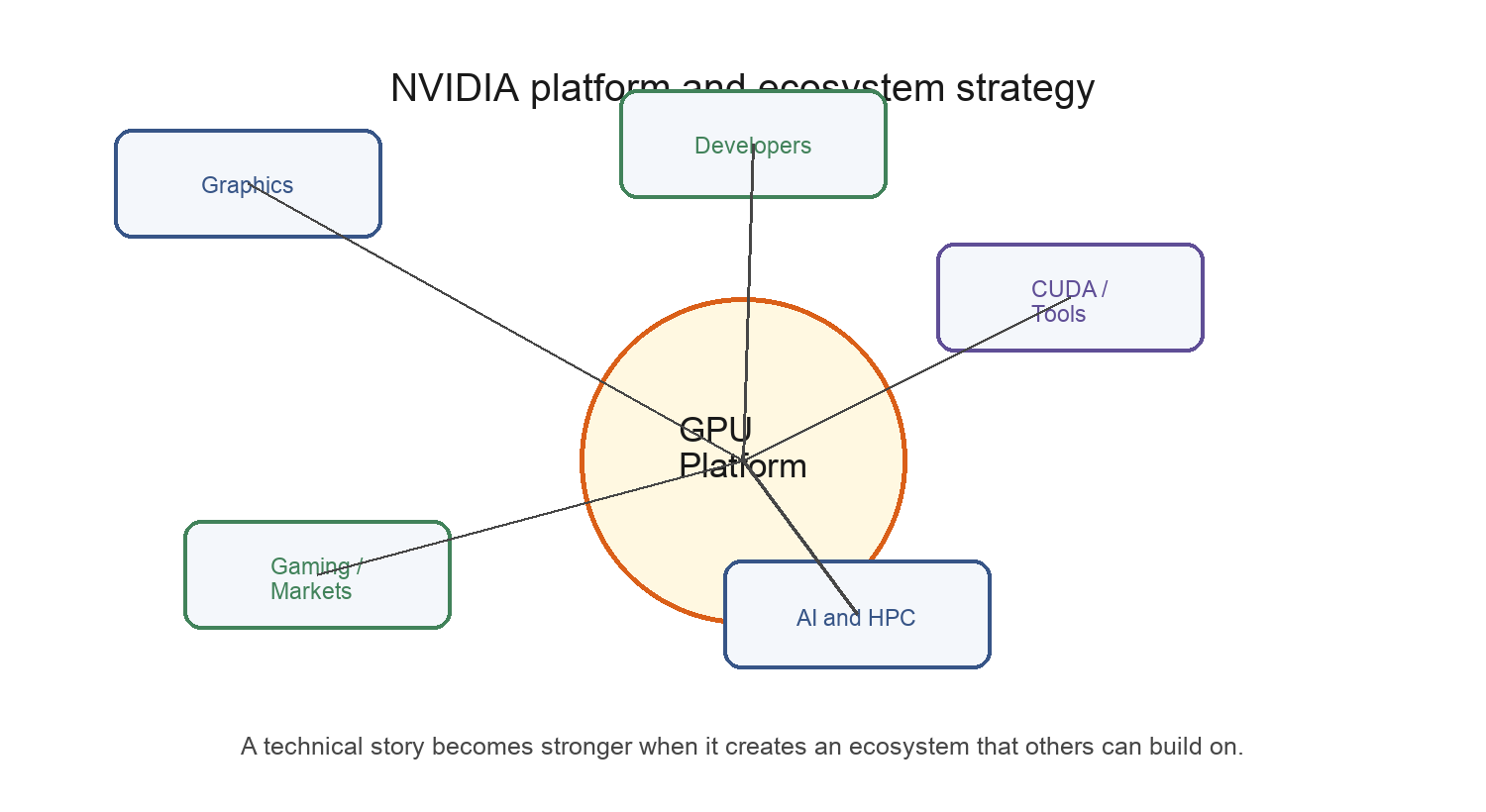
Figure 14. NVIDIA's platform and ecosystem strategy.
Initial Conditions
The case takes place during a sequence of product development releases. The business case for the next generation of GPUs already existed, but the technical story was changing. GPUs were moving from fixed graphics functions toward more programmable architectures that could support broader computation.
| In later-stage technical teams, innovation may begin inside a product roadmap. The opportunity is often hidden in a technical architecture change. |
Story
The story was not simply that NVIDIA would build a better graphics chip. The deeper story was that a graphics processing platform could become a more general computing platform. This required tools, programming models, developer adoption, and a broader ecosystem.
| A technical story becomes strategic when it explains how a capability changes what other people can build. |
Execution While Learning
The work required disciplined engineering execution. Teams had to solve detailed technical problems while keeping sight of the larger platform direction. Technical learning, architecture decisions, and market learning reinforced each other.
Behaviors, Mindset, and Leadership
The case illustrates truth-seeking behavior in a strong engineering culture. Technical organizations need enough openness to confront difficult facts, enough discipline to deliver, and enough imagination to see how a technical capability can open a new category.
| For technical innovation, culture is not decoration. It determines whether teams can find the truth, solve the hard technical problems, and stay aligned around a larger platform story. |
Summary
NVIDIA shows how technical behavior, architecture, platform thinking, and ecosystem development can combine to create long-term strategic advantage.
CHAPTER 08 | TECHNICAL BEHAVIOR
Technical Behaviors for Innovation

In the last section, we described a set of general behaviors and characteristics that support innovation. In this section, we will focus on the behaviors and mindsets that are the most appropriate for technical leaders and technical architects. The text explains how these behaviors intersect with entrepreneurial and innovation processes. Successful entrepreneurs/innovators have always known how to target the most valuable of problems by using storytelling, inductive learning, and agile implementation processes. In parallel, great technical architects have always understood how to solve complex problems by breaking them down to a fundamental systems-level, all while keeping the design as simple and effective as possible. We have observed that there are significant similarities between the entrepreneurial business process of creating a new venture and the technical process of creating, architecting, designing, and developing an early-stage technological innovation
System Architecture Development Entrepreneur/Innovator Start with the user’s story -> Get to Effective Implementation 1.0 Start with user’s story -> get to Business Model Break it down: first principals/relationships Use story to gather stakeholders/ resources Agile execution Inductive learning Minimal Viable System: Keep it Simple Minimal Viable Product for market fit Use broad thinking to reduce failures/flaws23 Use broad thinking to reduce business risk This table illustrates the parallels between System Development and the Entrepreneurship/Innovation Process From the table above, we can immediately see corresponding steps between the technical and contextual aspects of an innovation project. With these similarities in mind, we must also acknowledge the many aspects of the process which are specific only to the technical team. In the text below, we will focus on the best practices and behaviors that are the most relevant to the technical lead and the technical team. User-First Both the technical and business perspective should always start with the user’s perspective. Note, this is sometimes considered the customer’s perspective. The business objective is to find a working business model or mission model, while the technical objective is to 23 Could be written as increase robustness, increase reliability, reduce cost, increase performance (all are true while holding other variables constant)
get to an effective technical implementation. An important mindset for a technical leader is to begin with the user’s viewpoint first. It is only once this viewpoint is clearly established that the system architecture and the implementation can begin development. Break it down While the context lead is focused on using the story to gather stakeholders, customers, investors, team members, etc., the technical lead must evaluate potential solutions by breaking the proposed system down into simple sub-systems with minimal inter-connections. Critical thinking is always needed to understand the interactions and causal relationships between subcomponents. Of course, if a subcomponent already exists or can be easily obtained, then there is no need to build or redesign that subcomponent. For example, when Tesla created its battery, they began with the thousands of cells that were already being produced in mass scale, instead of designing a completely new battery architecture. Effectuation Great technical innovators and entrepreneurs all use “Effectuation Principals” in a natural manner. Roughly, what this means is to start by taking inventory of what you have first. By way of illustration, consider the process of making a home-cooked dinner. Would you first choose an intended dish, and then gather the ingredients (not effectuation)? Or, would you look at what you already have in the kitchen and then invent a new recipe from these ingredients (effectuation)? This principle can be applied to technical and business projects in the same manner. Look for Insight in the technical story Search for insight about the location of value, the power, or “the magic” in the system design. What will make it effective or exciting? This concept is a technical parallel to the entrepreneurial behavior
of understanding the user’s true needs, what they actually care about, or what they are willing to pay for. Minimal Viable System Architecture Get as quickly as possible to a 1.0 version. Distill the story as quickly as possible to the simplest possible implementation. From this, a more complex system can be evolved using an agile, iterative model to develop greater capability. This is parallel to the entrepreneurial approach of building a Minimum Viable Product (MVP) for testing product market fit, but in this case the focus is the system architecture for testing technical feasibility. Agile Increments and Flexible Technology Strategy: After developing a minimal demonstrable solution, use agile increments to prioritize further development:
1. Start with the simplest possible demonstration on the path to the best solution.
2. Use a technology strategy that allows for easy adaptation.
3. Be agile driven. Accept that it is impossible to predict the final product in advance. Keep it Simple The focus of the project should be on keeping the design simple, easy to explain, easy to verify, and easy to debug. Technical architects and designers are often interested in technically brilliant and complex solutions, but true elegance lies in simplicity. As quoted from a historical Apple advertisement, “Simplicity is the ultimate sophistication.” You might think of this in parallel to timeless works of art, which are characterized by having exactly what is needed to convey the message but not a single extra stroke of the brush.
Reduce the Downside Optimize to reduce the downside of risk and failure, not to maximize cost and performance. Always evaluate corner cases. This is the parallel of broad vs. narrow thinking within engineering. The broad thinking version in business would be used to avoid business risk as well as predict the expected outcome in the broadest terms. Measurable Objectives Develop measurable objectives to identify when goals are being achieved; you cannot improve what you cannot measure. For example, in a data science algorithm, how will you know that the prediction is good enough? Having both a measure and a target allows you to estimate whether the work needed to achieve a marginally higher result is even worth the expense of doing that extra work. To understand this more, learn about the concept of Value of Perfect Information. See Hubbard, “How to Measure Anything”, Wiley. Create a support ecosystem Build a support ecosystem with the highest quality partners that you can both reach and trust. Many technical leaders are tempted to reach out to the more convenient lower-quality contacts (team members, suppliers, partners, customers, etc.). These may be easiest to contact, but it will not result in the highest quality outcome. As long as trust can still be maintained, it is a best practice to push out of our comfort zones and find the most ideal people and organizations that we can.
Summary This section was written to provide a wide-ranging understanding of the behaviors and mindsets needed for technical teams and their leaders to successfully develop innovative projects. In case examples, we will see that these same behaviors come up frequently. We also note that behaviors beyond the ones listed have been identified in these cases.
Game-based Exercises: Technical Behavior
Choose one option, or assign two across consecutive class meetings. Each exercise should connect back to the team's current project evidence.
Picture Pieces Game
Why play: Technical contributors see how local technical work must assemble into one user-visible system.
Set-up: Choose a detailed image and divide it into equal pieces.
Play the Game: Each participant enlarges their piece, then the team assembles the whole.
Reflection Questions: Where did isolated work fail to align? How does this compare with APIs, interfaces, user flows, or system architecture?
Teamwork Lowest Score
Why play: Students feel why a technical team succeeds only when the whole system works.
Set-up: Assign a short technical-planning or design-review task to a team.
Play the Game: Grade the team by its weakest individual explanation of the design.
Reflection Questions: What did the team do to raise the floor? How should this change technical documentation and peer review?
Introducing the Imprint Energy Case
As you read the case, consider these questions:
1. How did Christine Ho's team move from research evidence toward business validation?
2. Why was reaching the true decision-maker different from receiving technical interest?
Case Study: Imprint Energy and Christine Ho
From Research to Company to Behaviors
Imprint Energy was co-founded by Christine Ho and Brooks Kincaid in 2010. The company commercialized an ultra-thin, flexible, rechargeable battery technology that could be printed. The case is useful because it shows the journey from university research to venture formation, business validation, and leadership development.
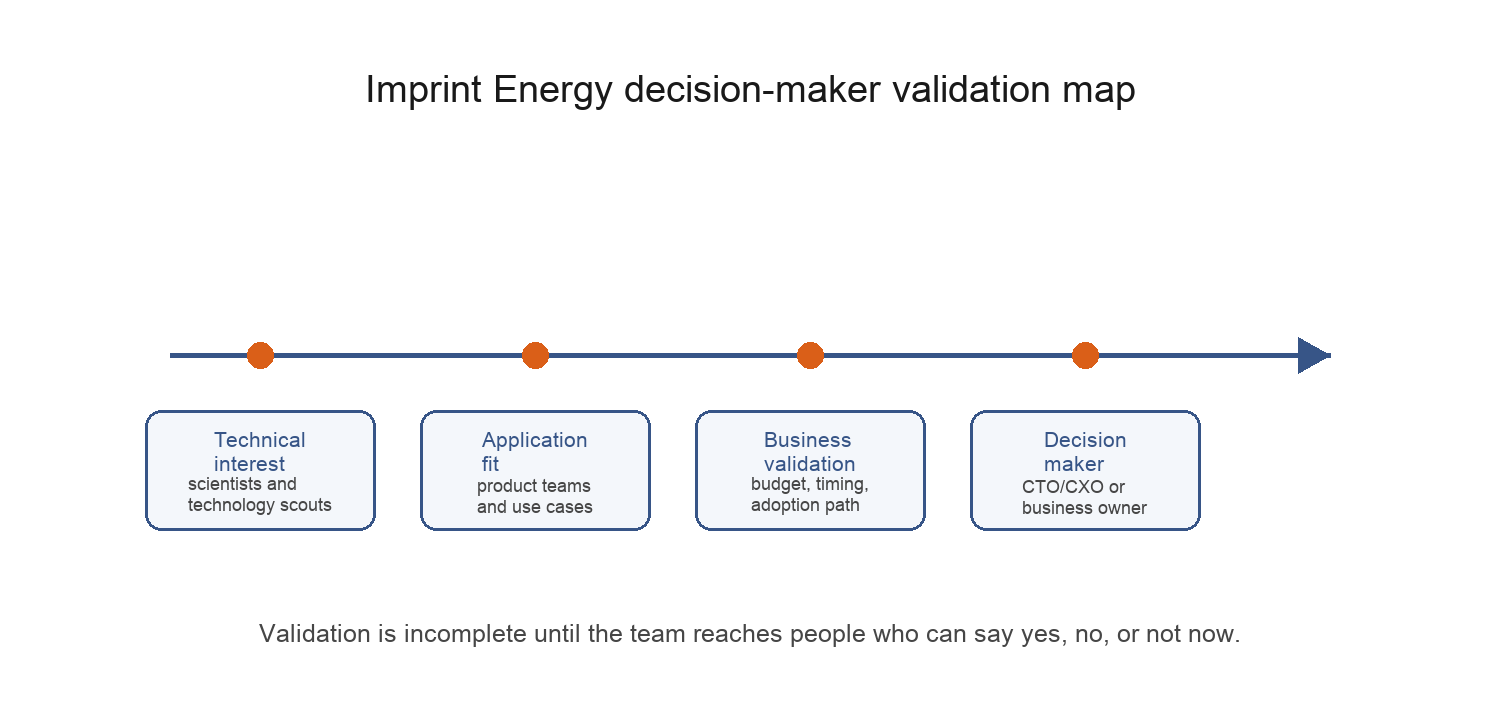
Figure 15. Imprint Energy's decision-maker validation map.
Initial Conditions
The roots of the company came from Christine Ho's Berkeley materials science research. Her work explored very thin batteries that could be printed and made environmentally safer. The venture began with research, then the intent to commercialize, then founding team formation, and then business development.
| Research can be the initial condition for a venture, but research evidence is not the same as customer or business evidence. |
Story
The team already had demonstrations and technical papers. The story therefore had to connect the technology to a product, market, and business need. The key question was not only whether the battery worked, but who needed it badly enough to help bring it into a real product.
| A deep technology story must translate technical possibility into customer value, adoption path, and decision-maker urgency. |
Execution While Learning
Imprint Energy learned through customer and partner conversations, product experiments, funding processes, and attempts to identify the right commercial applications. One recurring lesson was the difference between people who are technically interested and people who can make business decisions.
Behaviors Learned for Developing the Business
The case also shows the personal transition from researcher to executive. The leader must learn to communicate beyond the technical community, find decision-makers, negotiate partnerships, and keep the venture moving through uncertainty.
| Validation is incomplete until the team reaches someone with authority, urgency, and a path to action. |
Summary
Imprint Energy shows that technical progress and business progress are different but connected. A successful deep-technology project must advance both.
CHAPTER 09 | INTEGRATE
The Solution Explained in 12 Principles

Figure 16. Every innovation project is a journey.
Every Innovation Project is a Journey As we formally defined previously, Innovation Engineering is a framework to create or transform anything aided by aligning human talent in an efficient, effective, and positive manner. This framework offers practical guidance useful in large firms, research labs, new ventures, or even innovative student projects. Also reproduced from the first chapter is the illustration below. It shows that an innovation project is a journey and it outlines the elements of any successful innovation project: i) Initial conditions ii) A compelling story/strategy iii) Execution while learning iv) Innovative leadership, behaviors, and mindsets
As in the illustration, the Innovation project is a journey or sequence of steps. Framework Preview with 12 Principles Building upon the concept of a project journey, this section provides a preview of the major concepts of Innovation Engineering. It is written in the form of 12 principles. These concepts are explained in question and answer format and they characterize how teams successfully navigate innovation projects. Warning, this next section densely packed. We even use some terms without definition. This section is written in this manner to quickly preview the concepts of the book. In subsequent chapters, we will clarify these terms and expand these concepts.
Q1. How do Successful Projects Start? Principle 1. Start with Story: Innovative projects start with a story narrative. (E.g. NABC, AxB, "low-tech demo", or inspiring product demonstration). Many projects go wrong because they start with a list of requirements. However, by starting with a story such as a venture pitch, a “low-tech demo”, or NABC narrative (which was used by SRI during the invention of Siri), it allows the everyone to better understand and agree on the objective of the project from the beginning. Refence: Berkeley Method of Entrepreneurship (BMoE), Oracle Case, Netscape Case Q2. What is the difference between Story and Strategy? Principle 2. Strategy: Remember that strategy should be set by the question of "how will the project win" in context of your mission. Example: Story = Problem + Solution: People need to eat + we offer a new restaurant Strategy = What unfair advantage will we create? What actions will you take so that others will not be able do it cheaper, better, or faster. Business strategy is a set of investments and activities that allow a firm or project to have an unfair advantage. It is not enough to be able to offer a product or service, the offering must be produced at a lower cost, or have a capability that cannot be copied, serve a niche, or be differentiated in another way that others cannot easily copy. Reference: Strategy definitions of E&Y and others
Q3. What is Technology Strategy? Principle 3. Technology Strategy: A team should set technology strategy to achieve flexibility, speed, and ease of incremental development. Besides creating a strategy for the overall project, a technology strategy creates an advantage in the way that the product or service is put together. The choices of platforms, tools, and components can make a very large difference. It can be a great advantage when these choices make the speed of development faster or when they enable quick changes. In the NVIDIA case example, the product allowed the advantage of ease of programming not for itself, but for its customers which opened a new market for GPU processors. In addition, the most successful innovators also know how to solve complex problems by breaking them down to a systems-level, all while keeping the design as simple and effective as possible. Reference: NVIDIA Case Q4. What is the first decision to make to define a new project or product category? Principle 4. Project Scope: Choose a project scope or objective which the ecosystem will support. The project plan may include partnerships, ecosystem development, or internal stakeholders from the start. For example, when Caviar, the food delivery app, was first being created, they chose the scope of business to be food delivery services because they realized that restaurants would not mind giving up that service to other companies. The delivery service function was actually considered to be a distraction to the main business of most restaurants. Reference: Caviar Case Q5. How can we know if an early stage team is making progress? Principle 5. Team Evaluation: A successful project should have:
1. an exciting story
2. high powered execution
3. social progress
Not every team member has to have all capabilities, but trust and mutual appreciation among the team members is necessary. When investors or managers think about supporting a project, they need to consider all of these factors. Available at berkeleyinnnovationindex.org, there is a BMVS survey of under 10 questions that can help managers and investors evaluate a team based on these factors. Reference BMoE Q6. How does a team learn to execute something new? Principle 6. Execution while Learning: A team should use inductive learning and reflection to execute in new areas. Learning may occur in areas such as technology, tools, validation, business model, descriptive language, sales cycle or other areas. For example, for an innovative team with primarily technology-oriented members, the team may have to develop business acumen at the same time as building the product itself. As we will see in the next chapters, this type of learning advanced by observing the environment, separating knowns from unknowns, and repetitive self-reflection. Reference: BMoE Q7. How is inductive learning embedded into project execution? Principle 7. Agile Increments: Project execution is accomplished in agile increments, generally starting from the user’s touch point. This means that while the team is following its strategy, it develops the complete project increments. After each incremental step, a reflection process is used to understand what is working, what is not working, and what is most important to correct in the next incremental step. This is in contrast to mindlessly following a plan only to find that the resulting project has missed its objective. Reference: Design Thinking, Experiential learning
Q8. What does the team need to do after making a hypothesis? Principle 8. Test or validate everything: Always be able to separate what you know will work and what you don't know. Seek truth, avoid spin. For example, when NVIDA was testing its Fermi project, the product had a problem, but the obvious or simplest explanation turned out to be wrong. The best practice is to verify every assumption while trying to figure out the issue. The same is true for business and customers. Every assumption about what a customer wants must be validated no matter how obvious it seems. Reference: culture in NVIDIA Case Q9. To be an effective innovator, a person should know ____? Principle 9. Powerful tools: Learn to use enough powerful tools. Whether we are talking about software tools we teach in Data-X, the command line interface of a router, or business applications in a given industry, it is important to be proficient with multiple tools. The same is even true for theoretic tools. Richard Feynman, the famous Nobel Prize winning physicist, said that as a punishment, he was assigned to solve integrals in many ways. It turned out later that in solving complex problems, when others gave up, he had more “tools” that he could try, while others just did not have enough options. Reference: Richard Feynman, Data-X Q10. What is the job of the innovation leader? Principle 10. Innovation Leadership: A leader’s primary job is to select, recruit, support, and align the best team. The most important element within the team is trust. An innovative leader's downfall is insecurity and ego. The innovative leader should welcome feedback and develop the strength to avoid egotistical or insecure habits. (Reference BMIL)
Q11. What are some of the behaviors and mindsets needed by the team? Principle 11: Behavior and Mindset: Innovation behaviors across the team should include wide comfort zone, EQ, grit, and a balance of broad thinkers and reliable, operational/functional experts. The original team starts with mostly broad thinkers. Positive mindsets include • "I can accomplish or learn anything" (growth), • "Resources are abundant" (to avoid over-competition) • "Adversity can be channeled to become a source of strength” (motivation). Team members should affirm positive beliefs about themselves (confidence). (BMoE, BMIL, VMware Case). A related example made famous by Nike, suggests “Just do it” which is both growth-oriented and self-affirming in mindset is a better than “We are good at making shoes” which is a factual, but fixed mindset that may even constrain the company’s growth into new areas. Reference: BMoE, Dweck, Covey Q12. How can we make any environment better for innovation? Principle 12. Innovation Environment: An environment that fosters innovation should allow intellectually diverse types of people to mix/collide together under pressure and common purpose. It has been a hallmark of innovation at Berkeley that mixing talented people with different backgrounds and ideas, and putting them together on projects with common purpose has been a key to innovation. That innovation is stronger when people are mixtures of different professional segments from on-campus and off-campus. Whether you are creating or joining an incubator, a design firm, or innovative corporate environment, the key is the mixing and trust building of intellectually diverse, capable people who can find
common purpose together. Reference: Innovation Collider at Sutardja Center Summary In this section, we previewed the concepts of Innovation Engineering in 12 Principles. In the next chapters, we will explain these concepts in the form of as a step by step guide and in the order that maximizes their value for a project’s success.
Game-based Exercises: Integrate
Choose one option, or assign two across consecutive class meetings. Each exercise should connect back to the team's current project evidence.
Trading Game
Why play: Students close the course by noticing how story, trust, value, and action interact.
Set-up: Give each team a small object and a short time window.
Play the Game: Trade for more value while recording the story used in each exchange.
Reflection Questions: Which trades created real value? How did the final story differ from the first ask?
Videotape the Ask
Why play: Students practice making a credible next-step ask after the final demo.
Set-up: Each team prepares a one-minute request for a sponsor, customer, investor, or partner.
Play the Game: Record the ask and one response. Revise and record a second version.
Reflection Questions: What changed between versions? Was the ask specific, believable, and connected to evidence?
Appendix
Sutardja Center, the Back Story
In 2005, we launched the Sutardja Center for Entrepreneurship & Technology27 at UC Berkeley. For the first few years, we primarily used Harvard Case studies to teach entrepreneurship skills to student teams of engineers, scientists, and majors from across our campus. These studies would then be complemented by a classroom experience featuring the actual leaders and entrepreneurs who had written the case studies that we focused on. Over time, we discovered something that was key to the evolution of our program. It was that the actual people were more impactful than the case studies. Their behaviors, mindsets, and personalities were fundamental to teaching entrepreneurial capabilities at a psychological level. This led to an approach called Berkeley Method of Entrepreneurship (BMOE) where we would work to integrate the mindsets, behaviors, and psychology of entrepreneurship and innovation into our students — doing so while they were in the situation of developing a venture within a focused area. For example, within a “challenge lab” the entire class would work in a narrow venture area such as blockchain applications, medical devices for the third world, computer security improvements, or other emerging industry segments. During these technical developments, we worked in the background to add an educational basis that included inductive learning, story generation, team formation, and entrepreneurial behaviors for the students. 27 The center was launched in 2005 and formally named in 2015 by benefactors Pantas Sutardja and Ting Chuk
In parallel, we developed Data-X. We realized that being able to implement the technology was just as important as story generation and mindset. This emphasis on implementation led to the design of Data-X, a new type of “maker-oriented” technical course. Data-X was intended to be the course that anyone would want to take if they wanted to apply their skills in practice. The really unique thing about this course was that it showed that the entrepreneurial processes in challenge labs could also be brought into an otherwise completely technical course. The results were staggering. Projects of significant complexity were being completed and demonstrated in 12 weeks, rather than 2 years. The students experienced very positive outcomes, both in education and in real-life employment opportunities. Learn more about Data-X in the Case Study entitled “Data-X: A precursor to Innovation Engineering.” Over the years, two tracks began to develop: One focused on mindset, behavior, team formation, and story development, and the other focused on technical tools, architecture, and implementation.
Case Study: Data-X, A Precursor
Fostering the entrepreneurial process in data science innovations Data-X is a course at UC Berkeley developed and led by myself and Alex Fred Ojala launched in 2016. The Data-X class is an example of an applied data science course that was specifically designed to address the big picture needs of industry. It relates to the emergence of AI in different verticals, while also adopting lessons learnt from the Berkeley Method of Entrepreneurship (BMoE). The BMoE principles, which form the foundation of the Data-X program, stress the development of the right mindset for incorporating innovation with technology, which is not accounted for in most entrepreneurship curricula in academia. Later, concepts from this program were incorporated in the Innovation Engineering framework. Data-X Was Originally Designed to Address these Fundamental Problems:
1. A lack of applied or real-world experience in teaching data science
2. A lack of focus on implementation and powerful tools
3. A lack of integration between theory and practice
4. Correcting the mindset and behaviors required for innovative, technical projects Data-X was a Precursor to Innovation Engineering: In designing the Data-X class, we hypothesized that data science applications are very similar to entrepreneurship. There are no
specific rule-based methods enlisted in a book that can be used to derive value from data. The idea is bigger than teaching data science alone. Creating solutions and transformation of processes in the real world using data science are the innovation problems. To engender innovation in addition to technical skills, we need to train mindsets and behaviors of the individuals working on data science problems. We believe experiential training is the key additive ingredient in training mindsets and behaviors. The Data-X class ties to the ideas of BMoE which qualifies inductive teaching methodology to be more successful in teaching subjects that involve skill and mindset. Mindset, tactics and infrastructure are the three main components encompassed by BMoE. This method uses experiential teaching tactics that help students understand general concepts through practice, observation, critical thinking, and games. This method has been used at UC Berkeley in teaching entrepreneurship for the past four years. It has produced thousands of students as innovative leaders in developing entrepreneurial startups or innovation in big companies. In Data-X, we have attempted to use the BMoE method to teach innovation using Data Science. Data-X Methodology The figure below summarizes the data-x model, note the two simultaneous paths running throughout the course, one for learning concepts and tools and the other is the collaborative application of concepts and tools on the projects. The content covers math theory and computer science tools, yet at the same time, it includes a project which is developed from an insightful story and uses agile methods to create a solution. The idea is to make students aware of the state of art methods and tools used in the real world and let
them work in teams, think about problems in hand with different perspectives and create an insightful story to arrive at a solution. The Data-X Framework shows that story is developed prior to implementation in this early version of Innovation Engineering Data-X Results The result of combining story in the form of a low-tech demo along with theory and an execution while learning style including agile sprints has been effective. Data-X represents a model which is an early form of the Innovation Engineering framework The key results in the first two years have shown the following: 1. Delivery time of complex projects in shortened timescales of 13 weeks. 2. Demand of the course increased exponentially within 2 years.
3. Demonstrable applicability to job placement. 4. Development of innovative mindset and behaviors within a technical course. Project Case Examples: Data-X projects are publicly available and posted at the site: See https://datax.berkeley.edu/ The case examples that follow demonstrate a combination of story and agile implementation in a period of 12 weeks.
Index of Terms
| BMoE |
Berkeley Method of Entrepreneurship; a co-created pedagogy emphasizing entrepreneurial mindset, behavior, inductive learning, and project-based development. |
| Challenge-based project |
A project that begins with a domain challenge supplied by an expert or organization. |
| Execution while learning |
A way of working in which each build, test, interview, or demo creates evidence and changes the next step. |
| MVP |
Minimum viable product; the smallest version that creates useful learning from a real user or stakeholder. |
| NABC |
Need, Approach, Benefits, Competition; a compact structure for explaining a project. |
| Story |
The integrated narrative of problem, user, solution, change, and future state. |
| Technical story |
The explanation of how the product or system will work and what must be built or proven. |
| Traction |
Evidence of pull from users, customers, stakeholders, partners, or the technical environment. |
| Validation |
The process of testing whether assumptions about the problem, customer, value, product, or adoption path are true. |